Untold story of Schlagintweit brothers of Germany who explored the Himalayan with Nain Singh Rawat in 1855 onwards , Exhibition at India International Centre



An important exhibition which was inaugurated on 22 nd April at IIC Art Gallery, Maxmuller Road, Lodhi estate by a renowned artist, painter, Sculptor and Writer Ashok Bhaumik to be continued till 29 th April depicting and exhibiting the outstanding, magnificent and impressive paintings of true Himalayan Encounters with some of the real photographs turned into fascinating paintings maintaining its original colours, outlook and feel about 170 years ago left a remarkable impression on the mind and hearts of all those who ‘ve been to this event to date.
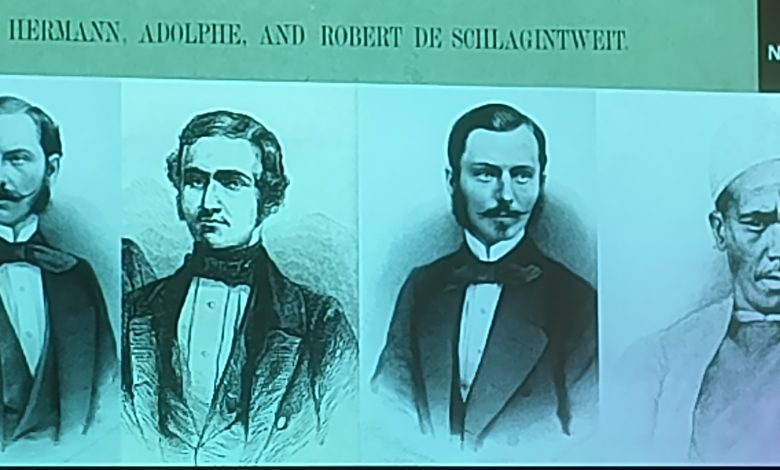
During the most challenging journey of the Himalayan landscapes including the Nainital and then mountainous terrains of Garhwal, Kumaon, Nepal and neighbouring Tibet, Yarkand, Leh Ladakh, Turkistan, etc etc the real heroes of these Expedition were the three Schlagintweit brothers of Germany namely Harmann ( 1826 to 1882), Adolph (1829 to 1857) and Robert Schlagintweit ( 1833 to 1885.
These three brothers could be pronounced as Geologists, glacialogists and artists who studied geography and geology and embarked on a protracted journey after being hired by the East India Company for the expedition of the Himalayas.
Earlier before embarking in this prolonged expedition of the Himalayas the three brothers trained their abilities by exploring the Bavarian Alps near Munich,
combining state-of-the-art theoretical knowledge and practical qualification.
In 1849, Hermann and Adolph moved on to Berlin, the capital of Prussia. Berlin then had become the new centre of geographical science in Europe, thanks to Alexander von Humboldt and Carl Riter.
These men had set a new trend in geography, focused on empirical observation and the cooperation of all natural sciences to understand the real world.
The Schlagintweits became friends with Humboldt, who was impressed by their scientific competence and their experience in mountaineering.
In 1852, Humboldt (aged 82) proposed to them a research task he had dreamt of for all his life: The exploration of the Himalayas.
In his place, the brothers should do the work desired Humboldt.
Humboldt presented the two young men to the King of Prussia and convinced the king to support his project.
Officially, the exploration would be the king’s idea. Finally in the king’s recommendation to the then East India company through his ambassador who was known to them the three brothers were employed by the Company to explore the Himalayas and report them.
Organised jointly by the FREIE UNIVERSITY BERLIN BY MR.HERMANN, ERNST -REUTER, GESELLSCHAFT, PAHAD , AND INDIA INTERNATIONAL CENTRE at the initiative of Padma Shri Dr. Shekhar Pathak and Chandan Dangi, this outstanding exhibition will also be organised in Nainital and Dehradun in the month of May.
This seven exhibition is unique and interesting today is because even after 170 long years, the drawings of Indian landscapes, glaciers, trees and buildings are the most interesting part of the Schlagintweits’ legacy are fully intact.
They give an idea of the state of Indian landscape and development in the last years’ of Company Rule in India.
The brothers brought back to Europe hundreds of drawings.
Their“General Register” (GR) counts 750 motifs, 420 thereof still existing.
More than half of the original stock had illustrated the Himalayas. Most of the drawings had been rapid sketches by pencil or pen, originally intended to remind important or complex details.
But soon the brothers understood the drawings as works of art, necessary to illustrate the different publications they planned. To adjust to the high contemporary standard of European book illustration, the drawings had to be completed and coloured.
This was mostly done by a group of landscape painters at Munich, whose manners can be identified by close inspection.
The Schlagintweits took a lot of notes explaining their drawings. Not to deface the originals, the authors did rapid copies of them, which could be annotated in the right places.
This project was termed as the Scientific Mission to India and High Asia, by order of the then Court of Directors of the East India Company (EIC).
Some hundreds of those copics, preserved at the Bavarian State Library, help to understand the scientific content of the drawings today.
The most important part of this story is that in the year 1855 , the Schlagintweit brothers apart from posessing a total staff of 100 persons they also included with them Nain Singh Rawat from Milum and Doctor Harkishan from Almora.
Two Schlagintweit brothers became temporary employees of the EIC with the main task to record terrestrial magnetism in India.
As an assistant, they took along their younger brother:Robert, a geographer and keen photographer.
Dominated by Alexander von Humboldt’s original idea, the Schlagintweits were mainly interested in the Himalayas.
Scientific work in the high mountains implied much more effort than travelling in the plains of India.
The brothers decided to divide their work according to regions and seasons:
Exploring the high mountains in summer, the hot plains in winter, Hermann would scrutinize the castern, Adolph the western Himalayas.
Unfortunately, the neighbouring states – Nepal, Sikkim, Bhutan, Tibet -denied the access to explorers working for Great Britain.
To get a better knowledge of the immense mountain region, the Schlagintweits travelled on separate ways along the old routes of Asian trade and pilgrimage – a total of 18, 000 miles.Their staff counted up to 100 persons.
The head staff participated in the principals’’regular scientific work of measuring, drawing, reading the many instruments.
The Schlagintweit acknowledged the abilities of their collaborators as Nain Singh Rawat from Milum, or the doctor Harkishen from Almora.
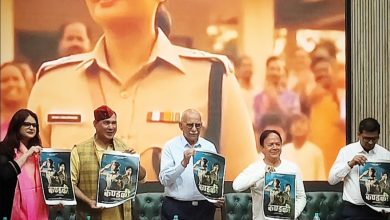
In the evening session at the IIC Art Gallery on 22 nd April there was an interesting event addressed by Dr. Harmann of Germany, the main organiser of this exhibition , Dr. Ashok Vajpayee a leading literaturer and professor Shekhar Pathak a leading acamedician and a renowned personality of Uttarakhand.
Many prominent personalities were present on this ocassion to name a few such as the former justice of Supreme Court Sudhanshu Dhulia, senior journalist Bharat Bhushan, K.C.Pandey, Chandan Dangi of Pahar, the main force behind organising this important event and exhibition, senior journalist Hridayesh Joshi, Sanjiv Chopra
and Shubhra Tandon from India
International Centre, Rashmi Pant, noted writer Veer Bharat Talwar, as well as Pankaj
Bisht, Dr. Harisuman Bisht, Bhupesh Joshi, Sunil Negi, Mahendra Latwal, Sanjay Joshi(Navarun), Khushhal Rawat, and Prakash Upadhyay. The gathering also included Vibhuti Sukhramani, Dr.Sanjeev Ranjan, Prof.
Malishree Lal, Rashmi Rawat from
University of Delhi, Russian language expert Hem Chandra, Kailash Pandey, and Vaishali. From academia, several faculty members and students from Jawaharlal Nehru University were present, including Prof. Saraindu
Bhaduri (Science Policy Department),
Prof. Sangeeta Dasgupta (History
Department), and Lala Ram, a
PhD scholar from the School of
International Studies.
The organizing team, including Chandan Dangi and Dr. Kamal Karnatak, was also actively present, contributing to the overall success of the event.
Dr. Shekhar Pathaks’s enumeration/ speech was outstanding in the sense that he provided every aspect of this Himalayan expedition by the three brothers of Germany and Pan Singh Rawat, Pundit of Pundits, title given by the Royal Geographical Society of London’s insights very minutely and interestingly keeping everyone glued to their seats.
He described Nain Singh Rawat as a remarkable personality , fully dedicated and a highly determined human being who despite dearth of everything those days living in abject poverty has walked nearly forty eight thousand miles on feet and confronted surmonting challenges.
According to Dr. Pathak Nain Singh Rawat’s total journey was (tentative)10000+ Km. before joining Sol and 26000+Km. as part of Sol and GTS.
He discovered more than 100 places, many communities, rivers, lakes, peaks, passes, mines & Gompas during his brisk walking journey till Tibet while passing through must challenging mountain paths and terrains finally reaching Kolkatta and then Delhi by train.
Nain Singh Rawat’s hard work was lauded in England by the Royal Geographical Society of India and was most respectfully known as the Cookie, Guide, Teacher, Surveyor, Trainer , Vernacular,Diarist Science writer and Explorer Extraordinarie.
A a mark of respect the statue of Pandit Nain Singh Rawat is installed at Survey Chowk Dehradun having been honored for his monumental work mapping Tibet and the Himalayas while working for the Great Trigonometrical Survey of India.
He was born in 1830 and breathed his last at the age of merely 52 in 1882. The London Geographical Society honoured him with the Gold medal for his outstanding contribution in mapping.
The Schlagintweit brothers were highly intrested to take Nain Singh Rawat to England to seek his experience and expertise while writing memoirs on their Himalayan expeditions but Nain Singh Rawat didn’t go and came back to his homeland due to social barriers though he was then still poor and fighting for existence despite so much of respect he had earned by the British and among the Schlagintweit brothers.
The Himalayan expedition was brought to end after the 1857 revolt against the British.
The organizing team, including Chandan Dangi and Dr. Kamal Karnatak, was also actively present, contributing to the overall success of the event. Kudos