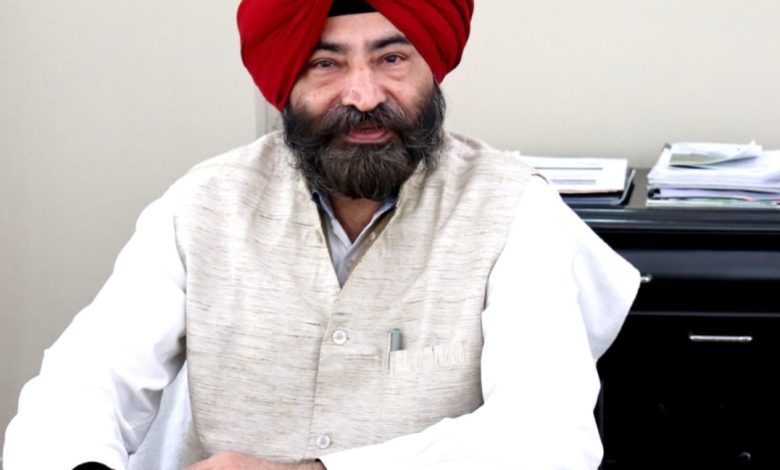
Senior journalist VIVEK SHUKLA in conversation with the Director Dr. Dr. Harinder Singh Oberoi, National Institute of Food Technology Entrepreneurship and Management, Kundli (NIFTEM-K), who is an acclaimed scientist
Indigenous Innovations: Ensuring Safe Food for Every Indian, Empowering Consumers: Indigenous Tech for Cleaner Milk, Paneer & Fruits, Food Safety Revolution: Simple, Smart & Affordable Detection Tools,

Vivek Shukla writes :
At the heart of India’s efforts to strengthen food safety, scientists are leading a significant push through innovative and accessible solutions that address everyday consumer concerns.
The National Institute of Food Technology Entrepreneurship and Management, Kundli (NIFTEM-K), an Institute of National Importance under the Ministry of Food Processing Industries, Government of India located on the Delhi-Haryana border, is at the forefront of this quiet revolution. Here, cutting-edge research ensures that the milk in your glass, the paneer on your plate, and the fruits in your basket are not just nutritious but genuinely safe.
In a country where food adulteration remains a serious public health challenge, affecting millions of consumers annually, institutions like NIFTEM-K are playing a pivotal role. From synthetic milk and banned pesticides to harmful ripening agents like calcium carbide, the threats are real and widespread, particularly in urban markets. It works directly addresses these concerns with practical, made-in-India solutions.
Dr. Harinder Singh Oberoi, Director of NIFTEM-K since August 2023, is guiding these efforts. An accomplished scientist, administrator, and educator with a Ph.D. in Microbiology from Punjab Agricultural University (PAU), Ludhiana, and international experience at Kansas State University, USA (2008-09), he previously served as Advisor to the Food Safety and Standards Authority of India (FSSAI).
“Food safety remains one of our foremost priorities,” says Dr. Oberoi. “Our scientists have developed groundbreaking nano sensor-based rapid test kits capable of detecting adulterants and assessing quality parameters in milk, paneer, and ghee. These ingenious paper-based dip-and-test strips are remarkably simple, rapid, user-friendly, and affordable. They require no sophisticated laboratory infrastructure, enabling on-site detection from processing units to retail outlets.”
These kits have received validation from FSSAI’s National Food Laboratory and have been transferred to a start-up for commercial production. Similar kits for detecting heavy metals in water, pesticide residues, added colours in tea, and calcium carbide in fruits are progressing through various stages of validation.
What sets these kits apart is their unique blend of scientific precision and practical usability. Protected by patents, registered copyrights, and industrial designs, they empower regulatory agencies, food businesses, and consumers with quick, reliable screening tools against adulterants and contaminants.
“Such indigenous innovations are crucial for strengthening India’s food safety surveillance system,” Dr. Oberoi emphasises. “Our endeavour is to see these kits reach consumers, assuring them of the safety of the food they consume every day.”
Under his leadership, NIFTEM-K is pursuing a bold vision: evolving into IIFTEM- the International Institute of Food Technology, Entrepreneurship and Management. “Transform NIFTEM to IIFTEM through creating entrepreneurship among the students, farmers, FPOs [Farmer Producer Organisations], rural and urban youth,” he articulates. This transformation aims to position India as a global leader in food technology and innovation.
Beyond food safety, the institute is building a robust ecosystem spanning research, innovation, entrepreneurship, incubation, and a vibrant start-up culture. Researchers are actively working on food fortification, sustainable processing, bio-processing, speciality foods, vegan and clean-label products, and plant-based alternatives. It has developed 72 technologies available for transfer to stakeholders. In just 13 years, NIFTEM-K has secured 13 patents (most commercialised) with 16 more applications under process. Its NIFTEM Technology Innovation and Business Incubation Facility (NTIBIF) has supported 65 start-ups and 25 Farmer Producer Organisations, creating a strong pipeline of viable food enterprises.
“We strongly believe that research should generate employment and entrepreneurship alongside scientific knowledge,” notes Dr. Oberoi. The institute maintains strong industry linkages to solve real-world challenges and is contributing meaningfully to reducing post-harvest losses while promoting sustainable food systems.
Looking ahead, Dr. Oberoi offers an inspiring message to young minds: “The future of food lies in science, innovation, and sustainability. Whether it is ensuring food safety, developing healthier foods, reducing post-harvest losses, creating sustainable packaging, or launching the next generation of food startups, the opportunities are limitless.”
“I invite young minds to become part of this exciting journey and help shape the future of India’s food sector,” Dr. Oberoi concludes.