SC directs the centre to reply within four weeks on the Data Protection Act that amends a crucial section of the RTI Act

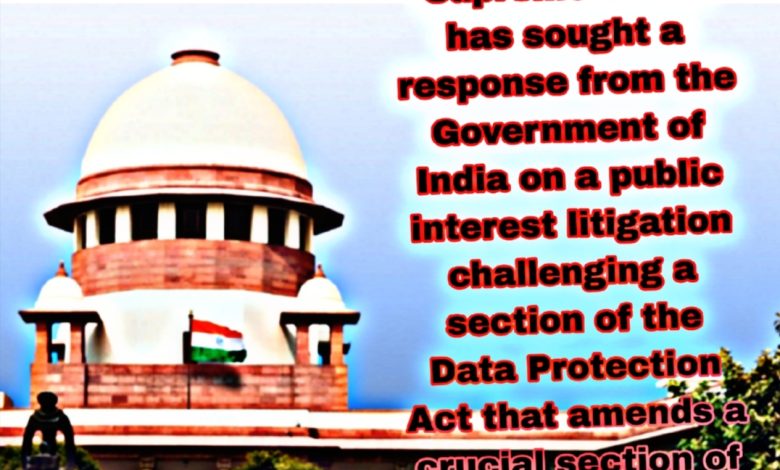
The Supreme Court has sought a response from the Government of India on a public interest litigation challenging a section of the Data Protection Act that amends a crucial section of the RTI Act.
The apex court has clubbed together the petitions of several individuals and NGOs and directed the centre to submit the response within four weeks.
The public interest litigation in the Supreme Court against the Digital Personal Data Protection Act (DPDP), 2023, has been filed primarily by individuals and organizations with petitioners being
Kishanbhai Maganjibhai Kanani, the main petitioner in this case,
who is an RTI activist, Anjali Bhardwa, renowned RTI activist and founder of ‘Satark Nagrik Sangthan’, Nikhil Dey – Co-founder of ‘Mazdoor Kisan Shakti Sangathan’ (MKSS) and a prominent figure in the RTI movement and National Campaign for People’s Right to Information (NCPRI), the organization which is also part of this legal challenge.
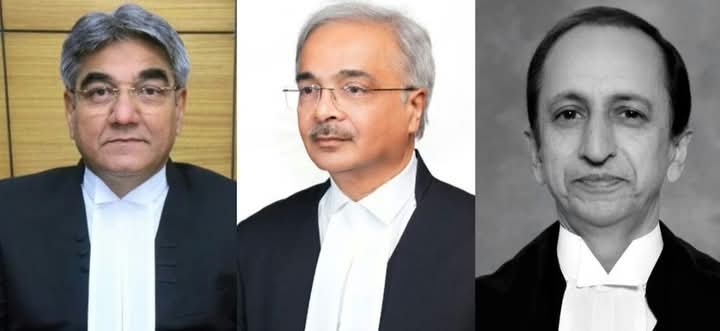
Given the gravity of the matter, a Supreme Court bench comprising Chief Justice (CJI) D.Y. Chandrachud, Justice J.B. Pardiwala, and Justice Manoj Mishra is hearing it.
The petitioners have argued that the amendment to Section 8(1)(j) of the RTI Act is unconstitutional. Under the original law, personal information could be disclosed if there was a public interest, but the new amendment completely prohibits this.
This is likely to have a profound impact on corruption investigations and government transparency.
Section 44(3) of the Personal Data Protection Act has a serious adverse impact on the crucial section 8(1)(j) of the Right to Information Act.
Given the importance and sensitivity of the matter, the Supreme Court has issued a notice to the Central Government.
Section 8(1)(j) of the RTI Act has been amended through Section 44(3) of the Digital Personal Data Protection Act (DPDP Act), 2023.
The petitioners argue that this amendment weakens the spirit of the RTI Act and reduces government accountability.
The main reason for the dispute is about the change in Section 8(1)(j)?
The original Section 8(1)(j) of the RTI Act provided that personal information could be disclosed if:
It is in the larger public interest.
The information cannot be denied to Parliament or the State Legislature.
Now with the implementation of the DPDP Act, all personal information has been excluded from the scope of RTI. The discretion to provide information based on “public interest” has now virtually disappeared.
The PIL challenging this major legal change, calling it unconstitutional, raises concerns on the following points:
Lack of accountability: Information related to the assets, educational qualifications, other eligibility criteria, and expenses of government officials can now be concealed under the guise of “personal data.”
According to the petition, this amendment defeats the very purpose of the RTI Act, which was enacted to prevent corruption and bring transparency.
This change violates citizens’ “fundamental right to know” under Article 19(1)(a) of the Constitution said the petitioners.
In view of the above the Supreme Court, considering the matter serious, has sought responses from the Union Ministry of Electronics and Information Technology (MeitY) and the Union Department of Personnel and Training (DoPT).
Given the gravity of the matter, a Supreme Court bench comprising Chief Justice (CJI) D.Y. Chandrachud, Justice J.B. Pardiwala, and Justice Manoj Mishra is hearing it.