SIR process unconstitutional and against electoral laws: former CEC S.Y. Quraishi and Intellectuals at Janhastakshep seminar demand immediate halt to SIR

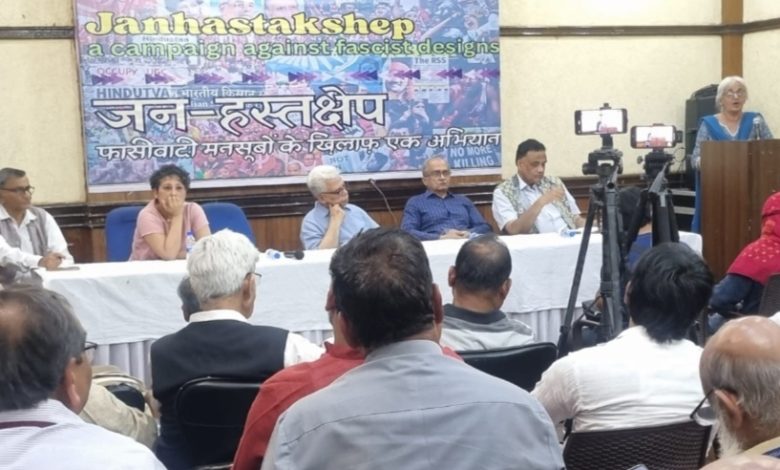

An important event took place at the Press Club of India on 18 April titled HASTAKSHEP in which many distinguished personalities gave their pivotal views on the ongoing “Special Intensive Revision” ( SIR) in the country especially in West Bengal where lakhs of voters have been left out , thus snatching from them their fundamental cunstititional right to vote.
Majority of these left out electorates are allegedly from minorities communities revealed the speakers.
The former chief election commissioner of India Mr. S.Y. Quereshi in his hard hitting speech stated that the entire process of the ongoing Special Intensive Revision (SIR) of electoral rolls across the country is a conspiracy against the people, unconstitutional, and in violation of laws governing electoral rolls and the election process.
He said that having one’s name in the voter list and the right to vote is not a favor, charity, or benevolence granted by any government or the Election Commission, but a constitutional right of the citizens.
The former CEC was speaking at the seminar titled ” Selecting the Electors: Mockery of Democracy”,
Janhastakshep
Campaign Against Fascist Designs” at the Press Club of India.
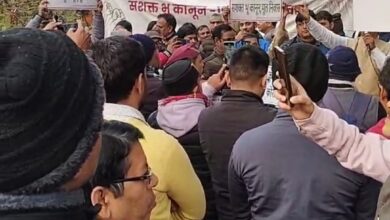
At the packed hall of the Press Club of India in New Delhi, participants—including intellectuals, lawyers, journalists, students, women, workers, and social activists—focused particularly on the adverse impact of SIR in West Bengal.
They passed a resolution demanding the immediate termination of the SIR process, which they said is against citizens’ rights, and called for continuation of the old electoral rolls and elections to be conducted on that basis.
In addition to the former CEC Quraishi, speakers at the meeting included Senior Supreme Court vociferous advocate Prashant Bhushan, IFTU National President Dr. Aparna, former OSD to the President Satyanarayan Sahu, former Delhi University professor Badri Raina, and Press Club of India President Sangeeta Barua.
The session was chaired and moderated by Senior Supreme Court advocate Ashok Panda. Earlier, Janhastakshep co-convenor Anil Dubey presented the framework for discussion. Despite heavy rain in Delhi, the hall remained full and discussions continued till late evening.

Mr. Quraishi said the entire SIR process is flawed and non-transparent, and that citizens are being deliberately harassed. Referring to Article 326 of the Constitution, he noted that its spirit was one of full inclusion, but now inclusion in the voter list is being treated as if it were a matter of charity, whereas it is a constitutional right. He suggested that since electoral rolls in West Bengal are incomplete, either the old rolls should be used or those with pending cases should be allowed to vote. He added that in the past, the Election Commission has ensured voting even in remote areas 1400 kilometers away with just a handful of voters. Today, after removing names from voter lists, millions are being told to file appeals and vote only in the next election after decisions are made.
Senior Supreme Court advocate Prashant Bhushan, explaining constitutional provisions related to voter registration, emphasized that voting is a right of citizens. He pointed out how millions are being deprived of this right. In particular, in West Bengal, the category of “logical discrepancy” is being used as a tool to harass voters.
IFTU President Dr. Aparna noted that in early electoral systems in England, voting rights were restricted based on gender and property. A similar situation existed in India under British rule, whereas India adopted universal adult franchise in 1950. She alleged that now the Election Commission and the government are effectively reintroducing a limited voting system, disproportionately affecting migrant workers, especially women. She also stated that in West Bengal, the ECI has brought even pre-2003 electoral rolls under scrutiny using the “logical discrepancy” category.
She further alleged that the ECI is working towards reinforcing the central government’s narrative of “foreign infiltration,” with support from the Supreme Court. In four border districts of West Bengal, 58.5% of deleted names belong to the Muslim community, while in four assembly constituencies of Kolkata, where Muslims constitute 20% of the population, 50% of names have been deleted. She said progressive and democratic forces there are demanding elections based on old voter lists. Citing data, she added that not only in Bengal but also in 12 states and Union Territories, and in Bihar, the highest deletions in published voter lists are among migrant workers, a large proportion of whom are women.
Press Club of India President Sangeeta Barua remarked that tribunals in Bengal resemble “foreigners’ tribunals.” She referred to the Assam model, where 1.9 million people were declared illegal, many of them Hindus, and are still allowed to vote with promises of future citizenship. She said SIR is essentially a question of citizenship.
Satyanarayan Sahu stated that SIR violates the values of Swaraj, Dr. B.R. Ambedkar, and Mahatma Gandhi. He emphasized that the Election Commission was established to remain independent of ruling parties. Special speaker Dr. Badri Raina also expressed concern over the current situation.
Concluding the meeting, Anil Dubey said that while people understand voting as a right, in practice the Election Commission’s process is depriving millions of poor people—especially minorities and Dalits—of their franchise, and this is particularly visible in a destructive manner in West Bengal. He added that SIR should be viewed in connection with delimitation and the “One Nation, One Election” proposal. According to him, this is an attempt by the present government to secure its electoral future indefinitely. Moreover, crores of poor people, a large number of them Muslims, may be removed from voter lists and deprived even of basic citizenship rights, creating a mass of disenfranchised people who would serve as cheap labor for corporate interests.
Finally, a resolution was unanimously passed with the following demands:
The SIR process underway across the country, including West Bengal, must be immediately halted. Alternatively, appeals filed by those whose names have been deleted should be decided promptly, allowing them to vote, or the 2025 updated electoral rolls should be used to ensure voting rights for all. Otherwise, the ongoing West Bengal Assembly elections will become meaningless.
The SIR process must be clearly redefined. The Election Commission’s role is to include names in voter rolls; it cannot demand or verify citizenship documents. Determination of citizenship is the responsibility of the Ministry of Home Affairs.
The meeting calls upon intellectuals, civil society organizations, and opposition political parties to strongly raise their voices against the arbitrary and flawed implementation of the SIR process, which is depriving citizens of their right to vote.