“How Dare a Magistrate Issue Notice?”: CJI Surya Kant Pulls Up Greater Noida Official Over Jantar Mantar Protester

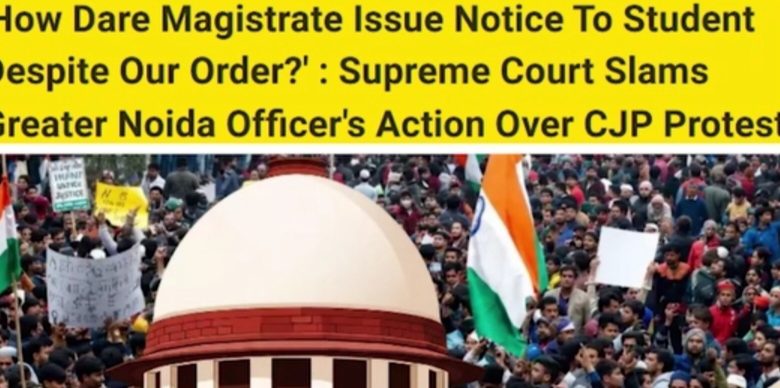

NEW DELHI, September 9: The Supreme Court on Wednesday came down strongly on the Greater Noida Executive Magistrate for issuing a notice to a second-year law student in connection with the Cockroach Janta Party (CJP) protests at Delhi’s Jantar Mantar, despite the apex court’s earlier order barring coercive action against students who participated in the agitation.
Chief Justice of India Surya Kant, heading a three-judge Bench with Justices Joymalya Bagchi and V. Mohana, questioned how the Executive Magistrate could issue such a notice after the Supreme Court had categorically directed that no coercive action be taken against students in connection with the protests.
“How could a Magistrate dare to issue notice? We made clear no coercive action against any student! No Magistrate could violate that order,” LiveLaw quoted CJI Surya Kant as saying.
The matter was brought before the Bench through oral mentioning by senior advocate Bishwajit Bhattacharyya, who informed the court that Akshat Tripathi, a second-year student of Gautam Buddh University, had been served a notice by the Greater Noida Executive Magistrate on September 4.
The notice, issued under Section 130 of the Bharatiya Nagarik Suraksha Sanhita (BNSS) following proceedings under Sections 126 and 135, required Tripathi to show cause why he should not furnish a ₹5 lakh personal bond and two sureties of ₹5 lakh each to maintain peace.
According to the police report cited in the notice, Tripathi was allegedly spreading “anti-government misleading talks” and encouraging fellow students to participate in a proposed CJP protest. The report claimed his activities could lead to tension and a breach of peace.
Tripathi has denied the allegations. He reportedly said he had not attended the university for nearly three months because of the vacation and subsequent online classes and therefore could not have been involved in provoking students on campus. The notice was subsequently withdrawn by the authorities.
The controversy assumes significance because, on September 1, the Supreme Court had invoked Article 142 of the Constitution to quash FIRs relating to the CJP-led student protests and made it clear that participation in a protest, by itself, would not constitute an offence.
The Court also barred fresh coercive action against students in connection with the protests, while preserving action in cases involving serious criminal conduct.
During Wednesday’s hearing, the student’s counsel argued that withdrawing the notice did not erase the alleged violation of the Supreme Court’s order, calling it a possible contempt of court and warning against creating a “fear psychosis” among students.
Justice Joymalya Bagchi asked whether any cause of action survived after the notice had been withdrawn. Counsel maintained that contempt, once committed, could not simply be purged by withdrawing the notice.
The Bench directed that the notice and relevant facts be placed on record and indicated that it would seek an explanation from the concerned authority. Tripathi has also filed a writ petition in the Supreme Court challenging the notice, alleging violations of his fundamental rights under Articles 14, 19 and 21.
The episode has triggered fresh questions over the implementation of the Supreme Court’s September 1 directions and the accountability of executive authorities in dealing with student protests.