VIVEK SHUKLA
In the recently concluded Asian Games in Japan, B. P. Ojha also heard the commentary of a couple of games, but he could not bear the appalling standard of our commentators in language and knowledge of the game. He switched off his radio and television to avoid the torture. He was among the most versatile Hindi commentators, and made his mark in hockey, cricket, football and table tennis.
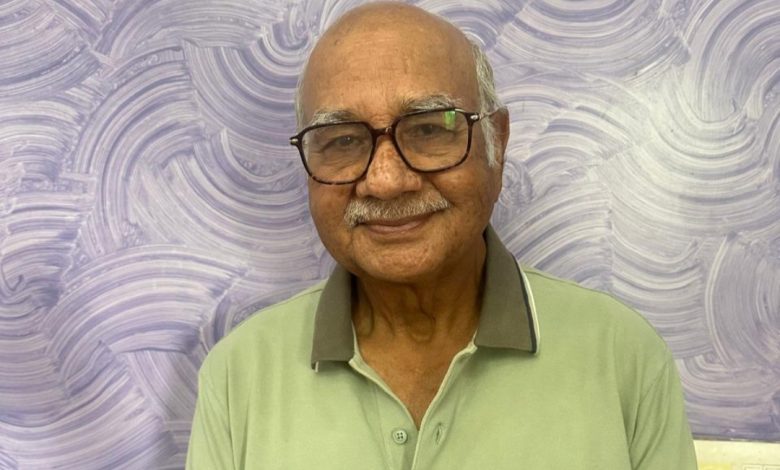
B. P. Ojha is a hidden gem of Hindi sports commentary. His voice, deep knowledge of sport and careful preparation gave a distinct identity to an important period of Indian sports broadcasting. Even now, countless fans who still follow sport remember his commentary. Ojha, who now spends his free time playing golf or reading, said that what passes for commentary these days is mostly noise. Commentators, he felt, are no longer serious about their language. Their speech is often crude and street-level, and their knowledge of the game is not of a high standard either.
To introduce Ojha only as a commentator would be to limit him. He was a state-level footballer and referee, and he also played in the Delhi Hockey League. Because he had played the game himself, he understood the fine points of the field, and that practical knowledge was a special strength of his commentary. “I played in the Delhi Football League for several years. My brother was also an ace footballer,” he says.
Ojha says he began commentating in 1978 and later made a name for himself in football, cricket, hockey, badminton and table tennis. In football he covered major competitions and finals, including the DCM Tournament, the Durand Cup, the Rovers Cup, the Santosh Trophy and the IFA Shield.
His international coverage was also notable. He commentated at the 1982 Asian Games in Delhi, the 1984 Asia Cup football in Singapore, the 1986 Hockey World Cup in London and the 1988 Olympic Games in Seoul. In cricket he covered the 1987 Reliance World Cup, including the India–England semi-final, as well as Test matches and one-day internationals. His work also included the India–South Africa one-day match at Eden Gardens. He says that now one cannot even tell whether the commentary of an important sporting event is being heard on radio or television. In his time, he says, people listened to the commentators’ language so that their own language would improve.
Ojha’s distinction was not only the number of sports he covered, but the preparation he brought to them. He was not someone who went to the microphone without doing his homework. Studying the players, the teams, the competition, the figures and the conditions of the match was part of how he worked. That is why, among the commentators of that period, his learning and preparation earned special respect.
His voice was heard from Delhi’s Shivaji Stadium and the National Stadium to the country’s leading football grounds and international venues. At major centres such as Salt Lake Stadium in Kolkata, and at many other important grounds, he carried the game to listeners in words. His long career also included the finals of prestigious tournaments such as the J.L.N. Gold Cup and the Indira Gandhi Gold Cup.
The most striking thing about him was his modesty. Despite so much knowledge and so long an experience, he never showed arrogance. Players, referees and people connected with sport held him in respect.
Ojha’s journey was not limited to radio. His move from All India Radio to television commentary was part of the change then taking place in Indian sports broadcasting. In the new medium, too, he kept the identity he had built through language, presentation and knowledge of the game.
The irony is that, despite so long and varied a career, Ojha was never one to publicise his own achievements. He treated the work itself as his identity. Perhaps that is why his record is not as widely known today as his contribution deserves.
B. P. Ojha is one of the few people who did not merely watch sport: he played it, understood it, tested it as a referee, and then carried it through his voice to lakhs of listeners and viewers. From football to hockey, and from cricket to badminton and table tennis, that many-sided presence gives him a distinct place in the history of Hindi sports commentary.
B. P. Ojha is truly a hidden hero of Hindi sports commentary- rich in knowledge, strong in preparation, vast in experience, and deeply modest by nature. His voice may no longer be heard as regularly as before, but his contribution to the history of Indian sports broadcasting deserves to be remembered for a long time.