Partition’s Unhealed Wounds Revisited: Thought-Provoking Discussion on Vivek Shukla’s Book ‘1947: Vibhajan Ke Shesh Sawal’ Held at IGNCA, New Delhi

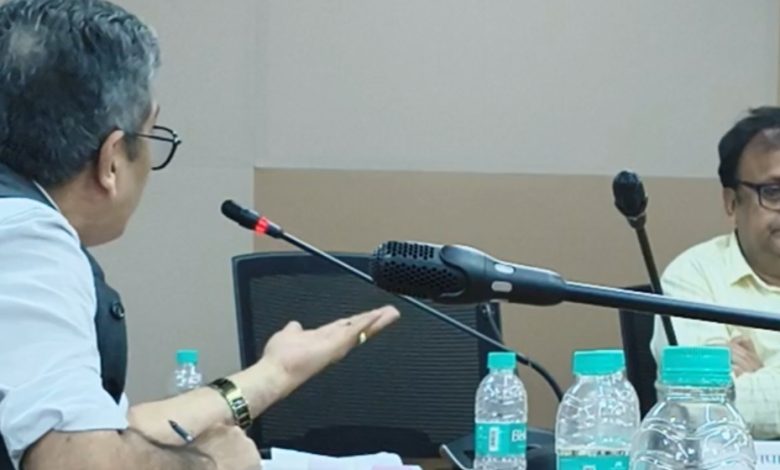

New Delhi: In a deeply moving and intellectually charged evening, the Indira Gandhi National Centre for the Arts (IGNCA), Janpath, New Delhi, witnessed a jam-packed hall where an extraordinary interactive event unfolded — a discussion on the powerful and timely book by eminent writer, senior journalist and prolific columnist Vivek Shukla, titled ‘1947: Partition and Its Unanswered / Remaining Questions’ ( 1947 – Vibhajan Ke Shesh Sawal ).

The event, organised by the Janapada Sampada Division of IGNCA, turned out to be much more than a book discussion. It became a collective journey into the heart-wrenching memories of 1947, its aftermath, and the questions that still remain unanswered even after 78 years of Independence.
Despite heavy traffic jams at Janpath and multiple police barricades and bottlenecks due to ongoing protests in central Delhi, literature lovers, historians, journalists, students and senior citizens kept pouring in, forcing organisers to arrange extra chairs. The hall was overflowing, yet pin-drop silence prevailed as speakers narrated stories of pain, uprooting and resilience.
A Galaxy of Eminent Speakers
The discussion brought together an impressive galaxy of personalities from literature, journalism, poetry, theatre, social activism, history and even bureaucracy, who shared not just academic perspectives but also deeply personal and ancestral experiences of Partition.
Among the prominent speakers were:
– Prof. Jaspal Singh, Vice Chancellor of Punjabi University, Patiala and former Ambassador to several African countries, who spoke about the immense trauma faced by Punjabi and Sikh families during displacement.
– Ravindra Kumar, veteran journalist of Hindustan Times, Times of India and UNI, who covered the 1971 Indo-Pak war, shared how Partition shaped India’s political and journalistic landscape.
– Dr. Ravindra Kumar, poet, writer and former Member of the Railway Board, narrated poetic and emotional accounts of families torn apart.
– Prof. Ravi Prakash Tekchandani, leading historian, writer and Professor at Delhi University, threw light on the Sindhi community’s exodus — a community that lost everything but never got a designated state or adequate rehabilitation.
-Dr. Rehan Fazal, senior journalist formerly with BBC, famous for his iconic broadcasts on historical personalities and film icons, connected Partition’s cultural rupture with the stories of artists and cinema.
The event was presided over by Dr. Sachchidanand Joshi, Member Secretary, IGNCA, who in his presidential address lauded the book as a courageous attempt to ask questions that mainstream historiography has often avoided.
The inaugural speech was delivered by Prof. Anil Kumar of IGNCA, who set the context by highlighting how Partition was not just a political division but a civilizational trauma.
A Masterfully Moderated Dialogue
The entire discussion was moderated with immense dexterity, sensitivity and sharp intellectual insight by senior journalist, writer and Editor of UKnationnews, Sunil Negi, who ensured that each speaker’s narrative blended personal memory with historical analysis, making the dialogue both informative and profoundly human.
Sunil Negi raised pertinent questions — Why did we not learn from Partition? Why are the wounds of 1947 still bleeding in the form of cross-border terrorism, communal distrust and displaced identities? His moderation kept the audience engaged till the very end.
The Author and His Magnum Opus
The author of the book, Vivek Shukla, is a renowned columnist, prolific writer and a voracious reader who has been writing for leading national newspapers and news portals for several decades. He has authored ten books.
His three books are especially popular and widely acclaimed:
1. Gandhies Delhi_
2. Dilli Ka Pehla Pyar – Connaught Place
3. Veer Vithalbhai Patel: Ek Sadi Ki Yatra
In ‘1947: Vibhajan Ke Shesh Sawal’, Shukla dares to ask questions that history textbooks skipped — What happened to the promises made to refugees? Why was the pain of Sindhis, Punjabis and Bengalis including Garhwalies , never given its due in national memory? Why did we fail to fix accountability for the bloodshed? The book is being hailed as a must-read for anyone who wants to understand the unfinished agenda of 1947.
The event concluded with a vibrant Q&A session where audience members, including many second and third-generation survivors of Partition, shared their own family stories, turning the auditorium into an emotional confluence of memory, history and healing.
It was, in every sense, an evening that reminded Delhi , a city built by refugees — of its own forgotten roots.