It wasn’t a 4.4 magnitude earthquake but a high altitude glacial collapse that led to the massive Nepal tragedy


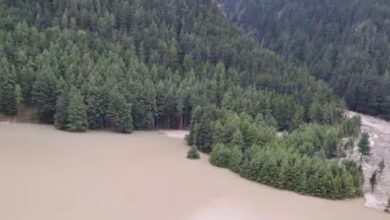
On the morning of August 26th, a wall of mud, ice and water originating from Tibet tore through Nepal’s Rasuwa district, triggering the deadliest flash flood Nepal has seen since last year. What initially looked like an earthquake-triggered disaster is now revealed to be something far more alarming – a high-altitude glacier collapse.
At around 8:37 AM local time, seismic stations along the Nepal-China border recorded a strong tremor. Initially reported as a 4.4 magnitude earthquake by the US Geological Survey, the signal has now been reclassified.
In a corrected bulletin, the USGS says – and I quote – _”No earthquake had occurred. The seismic event was instead a glacial collapse and debris flow, equivalent to a magnitude 5.2 event.”_
Satellite analysis by ISRO’s National Remote Sensing Centre, NASA’s Planet Labs, Kathmandu-based ICIMOD, and scientists from the University of Calgary has pinpointed the source.
High in the Langtang region, at 5,200 metres above sea level, nearly two-thirds of a glacier detached. According to Professor Daniel Shugar, University of Calgary, who compared satellite images from August 24th and 26th – “The lower part of a glacier broke off at 5,200 metres and crashed 1,200 metres down to the valley floor.”
Between 13 million cubic yards to ten times that – equivalent to at least five lakh dump trucks of ice and rock, travelling at speeds of up to 190 kilometres per hour.
This massive ice-rock avalanche crashed into the Lhende River, a tributary of the Bhote Koshi, about 20 kilometres northeast of the Rasuwagadhi border crossing, creating a temporary natural dam. Within minutes, the dam burst.
The burst released what scientists call a hyper-concentrated slurry – cement-like mix of melted glacier water, sediment, and boulders as big as houses.
ICIMOD confirms – at Galchhi, downstream on the Trishuli River, the water level rose by 9 metres, or 30 feet, in just 30 minutes.
The surge travelled over 150 kilometres downstream. Houses in Timure and Syaphrubesi were erased.
Between 165 and 359, as per Nepal’s Disaster Authority and Police – with 64 bodies recovered in Chitwan alone, 150 km from the origin.
– Missing: Over 823 people remain out of contact, including 579 tourists. Among them, 133 to 300 Indians, many Kailash Mansarovar pilgrims, 54 Americans, 34 Australians, 33 Britons. Eight South Korean nationals working on a hydropower plant are missing.
44 Nepal Army, 28 Nepal Police, 13 Armed Police Force missing.
– On the Tibet side, Chinese authorities report 3 dead and 558 missing in Gyirong County.
If we pinpoint to the infrastructural losses
– 19 bridges and 40 kilometres of highway washed away, including the Miteri Friendship Bridge connecting Nepal and China.
– 12 operating hydropower projects totalling 431 megawatts and 15 projects under construction totalling 470 megawatts damaged. Combined capacity hit: 901 megawatts. The 111-megawatt Rasuwagadhi plant’s dam has been washed away. Loss estimated at over 20 billion rupees.
– More than 200 trucks, 23 containers, 35 electric vehicles swept from the Rasuwagadhi dry port.
Scientists link it to accelerated melting. ICIMOD says glaciers in Nepal have melted 65 percent faster in the last decade than the previous one, wedged between two major carbon emitters. Meltwater percolated to the glacier bed, lubricated it, and triggered the collapse.
Construction of hydropower projects in the fragile zone may have added stress.
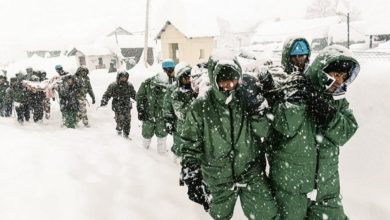
Nepal Prime Minister Balendra Shah has mobilized the Army, 1,100 Armed Police Force personnel, and 14 helicopters. Five districts – Rasuwa, Nuwakot, Dhading, Gorkha, Chitwan – are on high alert. The Indian Embassy has issued helplines – plus nine seven seven nine eight five one three one six eight zero seven. India, China and WHO have offered aid.
But danger is not over. Authorities are monitoring a still-dammed lake upstream in Tibet. A second flood warning remains in effect.
This was not a simple rainfall flood. It was a climate-driven, high-altitude avalanche that turned into a trans-boundary disaster.