Above photo by THE QUINT
– By Suresh Nautiyal Greenananda
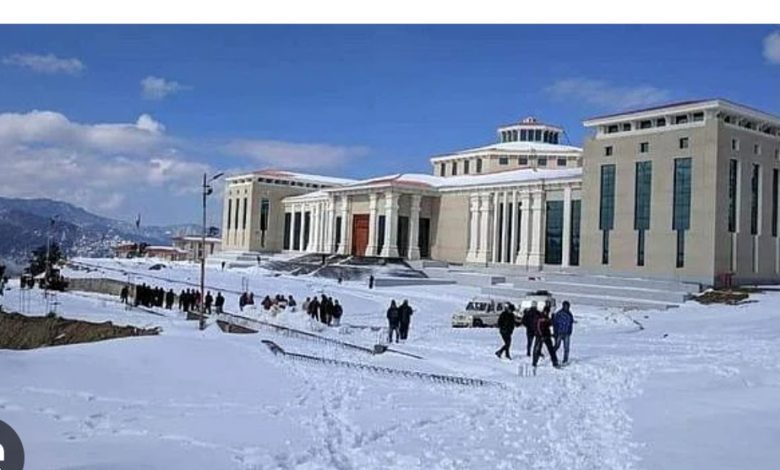
In recent political debates in Uttarakhand, a curious argument has resurfaced. That Bhararisain, situated in the middle Himalaya, cannot function effectively as a centre of governance because of its altitude. Some legislators of the ruling Bharatiya Janata Party have suggested that the height and climate make administration difficult. A few even argue that certain MLAs cannot endure the climate due to age or health conditions.
Such arguments reveal less about geography and more about poor political will. Mountains do not prevent governance; weak political imagination does. History across the world shows that altitude has never been a barrier to administration, diplomacy, or democratic functioning. Several capital cities in the world have very adverse climates.
Actually, what determines the effectiveness of a capital is not its elevation above sea level but the vision, commitment, and people-oriented leadership that governs from it.
Capitals in the Cold:
The altitude of Bhararisain — about 2,390 metres above the sea level — is not unusual for a political centre. Around the world, several capitals function at equal or even far greater heights.
Consider La Paz in Bolivia, widely recognised as the highest administrative capital in the world at about 3,650 metres. Despite its extreme altitude, La Paz remains a vibrant centre of governance, diplomacy, commerce, and culture.
Similarly, Quito in Ecuador stands at about 2,850 metres above sea level and functions as the political and cultural heart of the country.
Bogotá governs a major South American nation from an elevation of around 2,640 metres.
In Africa, Addis Ababa in Ethiopia, located at about 2,355 metres, hosts the headquarters of the African Union and serves as one of the most important diplomatic centres on the continent.
In the Himalaya itself, Thimphu governs Bhutan from an altitude of about 2,334 metres, demonstrating that mountain geography and modern governance can coexist harmoniously. Meanwhile, Mexico City in Mexico, located at around 2,240 metres, governs a nation of more than a hundred million people.
Closer to the Himalayan world, the historic city of Lhasa stands at roughly 3,650 metres above sea level. Life, administration, and institutional functioning continue in these high-altitude environments every day.
These examples remind us that mountains have never prevented governance. Instead, they have often strengthened societies by fostering resilience, community cohesion, and a deeper relationship with nature.
The Indian Experience:
India itself provides strong historical evidence. Leh in India lies at more than 3,500 metres, and Shimla at more than 2,200 metres above sea level. Shimla even served as the summer capital of British India. From this Himalayan town, administrators once governed an entire subcontinent — long before modern highways, digital communication, and rapid transportation existed.
Today, state capitals such as Gangtok, Kohima, and Aizawl operate efficiently in mountainous terrain.
If governance could function from such places in earlier centuries with limited infrastructure, it is difficult to claim that Bhararisain cannot function today in an era of advanced technology, digital administration, and improved connectivity.
Bhararisain and the Uttarakhand Movement:
The importance of Bhararisain lies not merely in geography but in history and symbolism. Located near Gairsain, it lies roughly between the Garhwal and Kumaon regions, making it geographically central to the state, and cultural cauldron.
This centrality was a major demand during the long Uttarakhand Statehood Movement. The movement was not only about creating a separate administrative unit; it was about bringing governance closer to the Himalayan communities whose lives were shaped by mountain realities.
For decades, activists argued that the political centre of the future state should be located in the hills rather than in the plains. Now, Bhararisain represents the partial fulfilment of that aspiration. It is, therefore, not merely an assembly complex but a historical symbol of the people’s struggle.
The argument to convert Bhararisain campus into a wedding destination is just a foolish and thoughtless argument from the tourism minister of the state.
The Politics Behind the Argument:
Another claim sometimes raised is that the Assembly complex at Bhararisain was constructed during the tenure of a Congress government, and, therefore, its legitimacy may be questioned.
Such arguments reduce governance to partisan rivalry. Public institutions do not belong to political parties; they belong to the people. Roads, hospitals, universities, and legislative buildings are collective assets created through public resources and public aspirations.
To dismiss Bhararisain because it was built under a different political dispensation is to ignore the principle of democratic continuity. Governments change, but institutions remain.
More importantly, politics that ignores the aspirations of mountain communities, risks alienating the very people whose struggles created the state.
A Green Perspective on Governance:
From the perspective of Green political thought — a philosophy that emphasises ecological balance, decentralised democracy, and people-centred development — the debate around Bhararisain reveals a deeper issue.
Governance must be rooted in the landscape and communities it serves. In a Himalayan state like Uttarakhand, policies concerning forests, rivers, migration, climate change, and sustainable livelihoods cannot be separated from the mountains themselves.
When legislators gather in Bhararisain, they are not merely attending a legislative session; they are physically present within the fragile Himalayan ecosystem whose future they must protect. The surrounding forests, valleys, and watersheds serve as a silent reminder of ecological responsibility.
Green Ideology insists that governance must be close to people and close to nature. In that sense, Bhararisain symbolises a model of governance that respects both the environment and the aspirations of mountain communities.
Leadership, Not Altitude:
Ultimately, the debate about Bhararisain exposes a fundamental truth: governance is not determined by altitude but by leadership.
Capable leadership can administer a state from a mountain valley, a desert settlement, or a coastal town. Ineffective leadership, on the other hand, can fail even in the most accessible cities.
Modern technology has further reduced geographical constraints. Digital governance, improved road networks, and communication systems allow decisions taken in a Himalayan assembly to be implemented across the state with efficiency.
Thus, the claim that altitude prevents governance is less a practical concern and more a political excuse.
The Real Question:
The real question facing Uttarakhand today is not whether Bhararisain is too high. The real question is whether political leadership is prepared to honour the aspirations that shaped the state’s creation.
A capital in the Himalaya reflects the identity of Uttarakhand. It symbolises the dignity of mountain communities and the ecological responsibility that comes with living in one of the world’s most fragile environments.
Height does not determine governance. Vision does.
If leaders govern with integrity, ecological wisdom, and commitment to the people, administration can flourish anywhere — whether in a valley, a plateau, or a mountain ridge.
And in the case of Uttarakhand, Bhararisain stands not as an obstacle but as a reminder of the very spirit from which the state was born.
( Nautiyal Greenananda is an independent journalist, formerly Consulting Editor of the UNI and now Contributing Editor of the Independent Ink )