
Nepal Flood Result Of Engineering Mindset That Tried To Re-Engineer Rivers And Mountains: Sunita Narain At Sustainability Meet

New Delhi, 4 Sept 2026
The flash flood on Nepal-Tibet border cast a shadow over the 8th International Conference on Sustainability Education (ICSE) 2026 that opened at India Habitat Centre on Tuesday, with speakers calling it proof that climate crisis is no longer a distant risk.
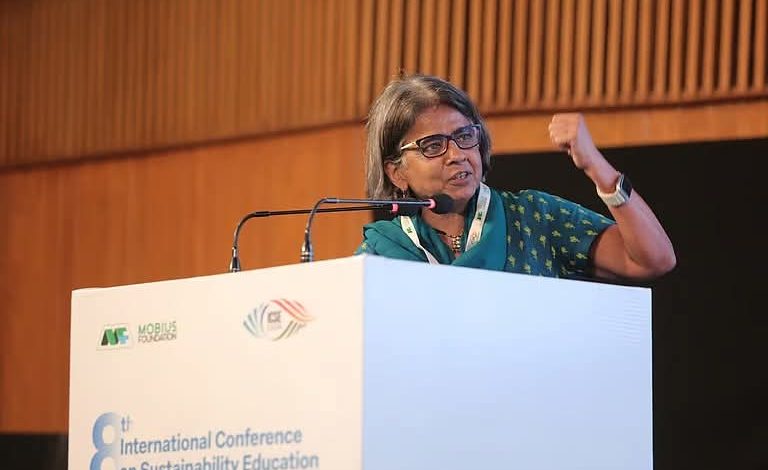
Delivering one of the sharpest interventions, Centre for Science and Environment (CSE) Director General Sunita Narain said Nepal disaster is a result of decades of an engineering mindset that assumed rivers and mountains could be re-engineered at will.
Citing CSE’s analysis of India Meteorological Department data, she said India is witnessing an extreme weather event almost once a day. Pointing to Yamuna, she said dissolved oxygen level falls from 6 mg/l at Delhi entry point to zero at ISBT, which she said is scientific proof, not sentiment, that river is dead.
“The one thing that we do not need more of is more reports and more incremental steps to fix what is today an existential crisis,” Narain said. She argued Delhi’s air will not be fixed by adding electric vehicles but by rebuilding public transport so people do not need to drive at all.
The inaugural session, convened by Mobius Foundation under theme “Sustainability Education for Transformative Action”, brought together policymakers, educators, scientists, industry leaders and youth.
Mobius Foundation President and CEO Priyanka Sharma, who anchored session, said sustainability has outgrown old environmental framing. “Sustainability is no longer simply an environmental conversation. It is a conversation about how we live, how we learn, how we work, how we create prosperity and ultimately how we create well-being and wellness for people and the planet,” she said, adding this year’s agenda moves from classroom education to green economy, critical minerals, e-waste and battery recycling, sustainable agriculture and green jobs.
Centre for Environment Education Founder Director Kartikeya Sarabhai placed conference in context of 50th anniversary of 1977 Tbilisi conference that first defined environmental education. He recalled India linking poverty and environment at Stockholm 1972 and inserting word “lifestyle” into 2015 Paris Agreement after US had resisted it at Rio 1992. He said eco clubs are being rolled out under Mission LiFE with target for every Indian school to have one by 2030, and NCF 2023 textbook making environmental education compulsory at Class 10 for first time. He proposed every school adopt one square kilometre to implement about 30 SDGs directly, noting India’s entire environmental education spend still trails advertising budget of a single soap brand.
TERI Director General Vibha Dhawan spoke to students, asking forgiveness on behalf of her generation for decades of resource use. Tracing shift from refilling surahi with tap water on train journeys to buying bottled water, she said Delhi doctors no longer see “pink lungs” in residents, comparing daily exposure to smoking 30 cigarettes. She flagged school transport policy gap where steep bus fees push families to private cars.
University of Cambridge Pro-Vice-Chancellor Bhaskar Vira spoke about Embers of Hope, 10-part documentary on India’s environmental future made with Mobius Foundation, filmmaker Robin Roy and narrator Zeenat Aman and broadcast on Warner Bros Discovery Network. He said most powerful educational moments came not from explaining science but turning it into human stories – retreating glacier as story about people depending on its water, air pollution as story about children struggling to breathe. Citing paper in Environmental Politics, he warned against “false hope” that technology alone will fix crisis and against despair, saying sustainability education should equip learners not only with environmental knowledge but capacity to engage as citizens in shaping transformations.
The two-day conference will have sessions on climate action, green skills, technology and innovation, biodiversity and sustainable livelihoods along with youth programming bringing students and young climate leaders from across country.