Owaisi–Chandrashekhar Azad Alliance: A New Political Challenge for SP-Congress in Uttar Pradesh; BJP Could Be the Biggest Beneficiary of Opposition Division
Samajik Parivartan Morcha seeks to consolidate Dalit-Muslim votes ahead of 2027 Assembly elections, putting Akhilesh Yadav's PDA strategy under pressure

By Sunil Negi
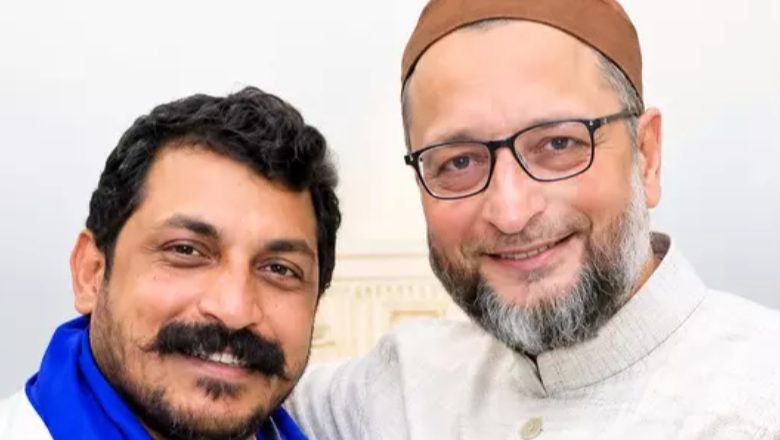
Lucknow, November 13, 2026: The political landscape of Uttar Pradesh has witnessed a significant new development ahead of the crucial 2027 Assembly elections, with the formation of an alliance between Asaduddin Owaisi’s All India Majlis-e-Ittehadul Muslimeen (AIMIM) and Chandrashekhar Azad’s Azad Samaj Party (Kanshiram).
Named the Samajik Parivartan Morcha (SPM), the new political formation could emerge as a major challenge to the existing opposition arrangement led by the Samajwadi Party (SP) and the Congress under the INDIA bloc.
More importantly, it has the potential to disturb the carefully crafted social coalition that SP president Akhilesh Yadav has been attempting to build through his PDA (Pichhde, Dalit, Alpsankhyak) strategy.
The announcement was made at a joint press conference in Lucknow on November 12, where Owaisi also declared Chandrashekhar Azad as the alliance’s chief ministerial candidate. The two leaders announced their intention to contest all 403 Assembly constituencies in Uttar Pradesh and invited other opposition parties, particularly the Samajwadi Party and Congress, to join their platform.
The announcement is politically significant because it brings together two leaders seeking to expand their respective influence among communities that have traditionally played a decisive role in Uttar Pradesh’s electoral politics.
A 40 per cent social constituency: The arithmetic behind the alliance
The political significance of this alliance becomes clearer when one examines Uttar Pradesh’s demographic composition.
Owaisi, meanwhile, has consistently attempted to expand AIMIM’s presence among Muslim voters, particularly in western Uttar Pradesh, Rohilkhand and other Muslim-influenced constituencies.
By joining hands, the two leaders are attempting to create a common political platform that combines Dalit mobilisation with Muslim political representation, while also reaching out to backward classes and other marginalised communities.
However, demographic strength should not automatically be confused with electoral consolidation. Dalits are not a politically homogeneous community, while Muslim voters have historically supported different parties depending on the constituency and the prevailing political circumstances.
Akhilesh Yadav’s PDA formula faces its first major challenge
The most immediate political challenge appears to be for Samajwadi Party president Akhilesh Yadav.
His PDA strategy — Pichhde, Dalit and Alpsankhyak — was designed to bring together backward classes, Dalits and minorities under one broad political umbrella to challenge the BJP.
The SP has been particularly successful in attracting substantial Muslim support, while its outreach to non-Yadav OBC communities and Dalits has been central to its strategy of expanding beyond its traditional support base.
The emergence of the Owaisi-Azad combination threatens to create competing political claims over precisely these constituencies.
For the SP, the Muslim vote is particularly important. Even a relatively modest shift in Muslim support towards AIMIM in closely contested constituencies could have consequences for the party’s electoral prospects.
Similarly, Chandrashekhar Azad’s attempt to attract Dalit voters could create difficulties for both the SP and BSP, especially in constituencies where Dalit voters could determine the outcome.
The challenge is not merely about the transfer of votes from one party to another. It is also about whether the new alliance can persuade voters that it offers a credible alternative government rather than simply another electoral platform.
Why the BSP cannot be ignored
An equally important dimension of this emerging political equation is Mayawati’s BSP.
For decades, the BSP remained the principal political vehicle for Dalit assertion in Uttar Pradesh. Its electoral success, particularly its absolute majority in 2007, demonstrated that a carefully constructed social coalition could translate into political power.
However, the party’s electoral decline has opened up space for new political formations.
Chandrashekhar Azad is clearly attempting to capitalise on this opportunity. His political appeal, particularly among sections of younger Dalit voters, could become a significant factor.
But it would be premature to assume that the BSP’s traditional Jatav support base or its wider Dalit constituency would automatically migrate to the new alliance.
Mayawati continues to possess an established organisational structure, a recognised political identity and a support base that cannot be dismissed.
Consequently, the new alliance could find itself competing not only with the SP and Congress but also with the BSP for the same section of the electorate.
The BJP’s opportunity: Opposition fragmentation
The most interesting aspect of this new political development is its potential impact on the BJP.
Chief Minister Yogi Adityanath and the BJP are seeking a third consecutive term in Uttar Pradesh. The party will be keenly watching the emerging differences within the opposition camp.
The 2024 Lok Sabha election demonstrated that a coordinated opposition can seriously challenge the BJP in Uttar Pradesh.
The Samajwadi Party won 37 Lok Sabha seats, the BJP 33 and Congress six. The BSP failed to win a single seat. Chandrashekhar Azad’s party won the Nagina constituency.
That electoral outcome was a major demonstration of the importance of opposition coordination.
Now, the emergence of a separate Dalit-Muslim political formation could complicate that equation.
If the SP, Congress, BSP and the new Samajik Parivartan Morcha contest separately, the opposition vote could become divided across several constituencies.
This could benefit the BJP even where its own vote share does not increase substantially.
The danger is particularly pronounced in closely contested seats, where a relatively small number of votes can determine the winner.
Uttar Pradesh has 403 Assembly constituencies, including 84 seats reserved for Scheduled Caste candidates, not 86 as sometimes mentioned in political discussions.
These constituencies will be particularly important in the coming election.
The new alliance hopes to establish itself as a serious contender in these constituencies by bringing together Dalit political mobilisation and Muslim electoral support.
However, the implications extend well beyond the reserved constituencies.
There are numerous general constituencies where Dalit and Muslim voters together constitute a substantial proportion of the electorate. Political observers have identified around 41 constituencies where their combined presence exceeds 50 per cent.
Western Uttar Pradesh and Rohilkhand could therefore become important battlegrounds for this new political experiment.
The BJP could benefit from a divided opposition in both reserved and general constituencies.
However, the political realities are considerably more complicated.
Akhilesh Yadav is attempting to establish the SP as the principal opposition force and the leading claimant to the chief minister’s office. Accepting an alliance in which Chandrashekhar Azad has already been projected as the chief ministerial candidate by Owaisi could create a serious political and leadership dilemma.
The Congress, too, would have to consider its political ambitions and the existing understanding with the SP.
There is also the question of whether the new front is genuinely willing to accommodate other parties on equitable terms or whether its leadership arrangement is already substantially settled.
The November 26 Constitution Day rally announced by the two parties in Lucknow could provide further clarity on their organisational ambitions and the response they receive from other opposition formations.
What does the new alliance mean for the 2027 electoral battle?
The Samajik Parivartan Morcha has announced its intention to contest all 403 Assembly seats. However, the detailed seat-sharing arrangement between the two partners is yet to be announced.
The alliance has also placed education, healthcare, unemployment, farmers’ concerns and the welfare of marginalised communities at the centre of its proposed political agenda.
Its eventual electoral performance will depend on several factors:
Whether Chandrashekhar Azad can expand his Dalit support base beyond his existing political strongholds.
Whether Owaisi can convert his influence among sections of Muslim voters into actual Assembly victories.
Whether the alliance can attract non-Yadav OBC communities and other marginalised groups.
Whether the BSP retains its traditional Dalit constituency.
Whether the SP-Congress alliance remains intact and manages to prevent fragmentation of opposition votes.
Whether the new front develops a credible booth-level organisation across the state.
There is also an important distinction between announcing candidates across all 403 seats and possessing the organisational strength to contest them effectively.
The larger political message
The formation of the Owaisi-Azad alliance has undoubtedly introduced a new dimension into Uttar Pradesh politics.
It is an attempt to challenge the established political leadership of the SP, Congress and BSP by claiming that Dalits, Muslims and backward communities should not merely function as vote banks but should have a greater share in political power.
For Akhilesh Yadav, the challenge is to protect his PDA constituency without conceding political space to emerging rivals. For Mayawati, it is about defending the BSP’s traditional social base. For Owaisi and Chandrashekhar Azad, it is about proving that their combined political strength can translate into electoral success.
Ultimately, the 2027 Uttar Pradesh Assembly election could become less about the numerical strength of individual communities and more about which political formation succeeds in bringing them together under one credible leadership.
If the opposition fails to arrive at a workable understanding, the division of Dalit, Muslim and backward-class votes could provide the BJP with a significant electoral advantage. The emerging Samajik Parivartan Morcha may therefore prove to be not just a new political alliance, but potentially one of the most consequential developments in the run-up to the 2027 Uttar Pradesh elections.