Nepal Death Toll Climbs to 469 in Flash Floods, Kathmandu Declines India’s And Other Countries’ Rescue Offers Saying Own Forces Capable

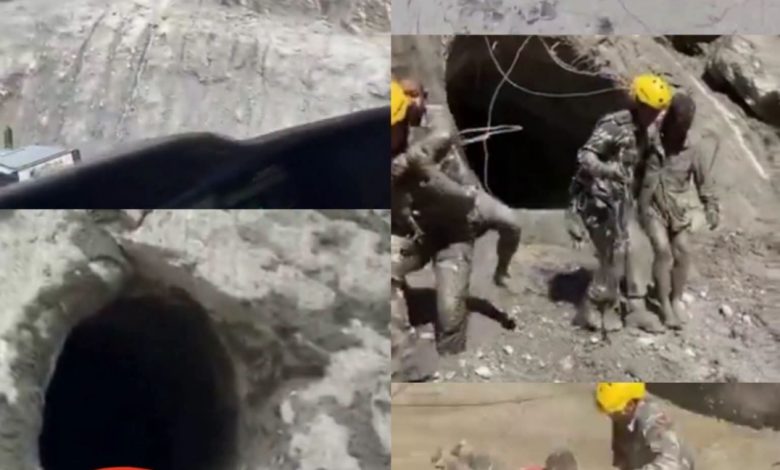
(Pics grabbed from social media )
Sunil Negi
The death toll from the catastrophic flash floods that struck Nepal on Wednesday has risen to 469, with rescue teams racing against time to trace hundreds of people feared washed away or trapped along the Bhote Koshi-Trishuli corridor, one of the worst hit regions in the Himalayan nation. Continuous heavy rainfall, glacial lake outburst and landslides triggered by overflowing rivers have devastated dozens of settlements in Rasuwa, Sindhupalchok, Dhading and Nuwakot districts, where houses, bridges, hydropower projects and stretches of the Pasang Lhamu Highway have been swept away, leaving entire villages cut off from road connectivity and electricity for the third consecutive day.
Amid this unfolding humanitarian crisis, several countries including India, China, the United States, United Kingdom, Japan, South Korea, Sri Lanka and Bangladesh offered immediate assistance for relief and evacuation operations. However, Nepal has politely declined any foreign rescue teams on the ground, stating that its own security agencies are fully capable of handling the search, rescue and relief operations at this stage.
Addressing media queries on Friday, Nepal’s Ministry of Foreign Affairs spokesperson Lok Bahadur Chhetri said that while offers of help are natural in such disasters, there is no need for foreign rescue assistance at present. “Offers of help are natural. Our security agencies are conducting search and rescue operations. At the moment we do not need such foreign help,” Chhetri said. A senior official of the Ministry of Foreign Affairs told The Kathmandu Post that similar requests had been received from China and other countries but had to be declined.
According to Nepali news agency reports, the government took this decision drawing lessons from the bitter experience of the 2015 earthquake when an overwhelming number of foreign rescue teams, unregulated aid agencies and media crews had landed in Kathmandu leading to chaos at the only international airport, logistical bottlenecks and coordination problems. This time, the government has not given green signal to any external rescue team, asserting that Nepal Army, Armed Police Force and Nepal Police are conducting operations in a coordinated manner.
It is true that Nepal has not allowed India, China and other countries to send their forces for relief and evacuation, despite formal offers. India’s National Disaster Response Force had kept two teams on standby in Gorakhpur and Bagdogra after the Ministry of External Affairs reached out to Kathmandu following Prime Minister’s condolence message, but the offer was respectfully turned down. Sources in New Delhi confirmed that India was told that Kathmandu would seek help if the situation goes beyond national capacity, but for now it wants to manage on its own.
On the ground, the situation remains grim. The Department of Hydrology and Meteorology said that water levels in Bhote Koshi and Trishuli are still above danger mark though rains have subsided slightly since Friday morning. Over 3,500 people have been evacuated to safer locations by Nepal Army helicopters, while more than 800 are still reported missing. Over 1,200 houses are fully damaged and 18 motorable bridges have collapsed. The Rasuwagadhi hydropower project has suffered extensive damage, raising fears of power shortage. Relief materials including food, tents and medicines are being air-dropped in inaccessible areas.
The government has announced a compensation of Rs 2 lakh each to the families of the deceased and free treatment for the injured. Prime Minister K P Sharma Oli, who visited the affected areas by helicopter on Thursday, said the focus is on saving lives and opening blocked roads within 48 hours. Opposition parties have, however, questioned the decision to refuse foreign help, saying that when lives are at stake, Nepal should not hesitate to accept specialised search and rescue equipment like thermal drones and heavy-lift helicopters.
India’s Ministry of External Affairs has said it respects Nepal’s decision and remains ready to provide any assistance including relief materials, medicines and financial aid through diplomatic channels if requested. For now, Kathmandu has said it will accept only humanitarian relief materials if needed, but not foreign boots on the ground.