SUPREME COURT ISSUES NOTICE TO THE CENTRAL GOVERNMENT, TERMS THE UGC GUIDELINES AS IRRELEVANT , NEXT DATE FOR HEARING IS MARCH 19, MATTER KEPT IN ABEYANCE

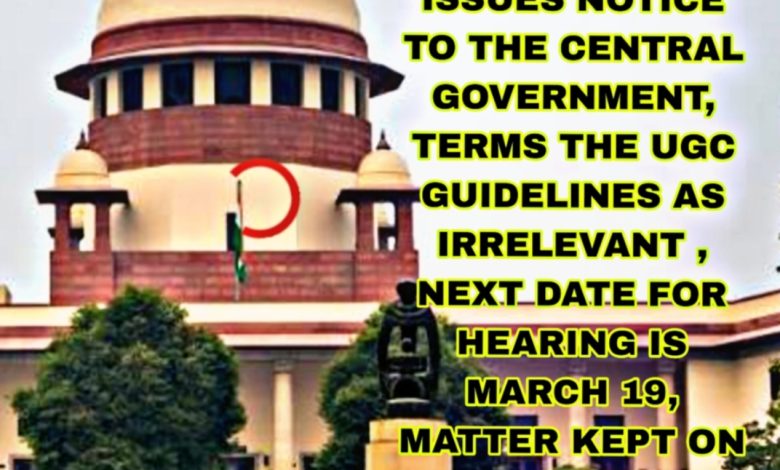
The Supreme Court of India has granted stay on the UGC guidelines today and fixed the next day of hearing for 19 th March.
The apex court has on Thursday termed the UGC’s Promotion of equity in higher education regulations 2026″ law as completely inadequate and the one having the possibility for misused putting it in abeyance issuing the notices to the central government / University Grants Commission directing them to appear before it on 19 th March with satisfactory reply clearing their positions satisfactorily.
Terming this new act as irrelevant,unclear and misuse oriented by the SC is, in a way a huge rebuff to the central government.
It may be recalled that there is immense resentment in the country over the new UGC regulatory mechanism.
The forward caste community and the students are outrightly rejecting it coming out in open protests with even All India Brahmin Organisation writing to the union education minister registering its strong protest and demanding its immediate withdrawal.
It catagorically said that institutions of higher learning are constitutionally and morally bound to operate on the principles of merit, competence, fairness and equal opportunity.
Any regulatory action that directly or indirectly compromises these principles, weakens academic standards, erodes institutional credibility, and damages India’s global intellectual standing is not acceptable to them further stating that the impugned UGC order raises grave and non-negotiable concerns.
The Supreme Court had agreed to hear the petition filed against the UGC rules a day earlier, i.e. on Wednesday.
The petition said that these rules could create discrimination against students from the general category.
The matter is Rahul Devan and others vs Union Government of India.
The CJI Surya Kant had listed the matter for hearing today.
After hearing the arguments and feeling convinced – the supreme court immediately stayed it for the time being keeping it in abeyance and giving the next date for hearing on March 19 th.
A bench headed by CJI Suryakant stated that these provisions were prima facie unsound and could be misused. The Supreme Court issued notice to the court and sought a response.
How long will the new UGC regulations be put on hold?
The Supreme Court has directed that the 2026 UGC regulations, which address caste-based discrimination, should not be implemented. The 2012 regulations will remain in effect until the Supreme Court examines the constitutionality of the new regulations.
The chief justice directed the solicitor general to form a high level committee of the dignitaries who are deserving and knowledgeable in order to investigate this matter thoroughly enabling our society develop together without any discrimination.
The chief justice asked whether the complaint about ragging will be heard under this act to which the counsel said that not only there is no definition of ranking in the rules, the fresher can go to jail in the first month itself adding further that these guidelines of UGC are exclusively caste based regressive and the one creating a divide between the seniors and juniors ( student community). The CJI pout four consecutive questions : (1) Will this rule apply to political/symbolic jibes against students from the Northeast or Northeast? (2) Is there any remedy if one group within the SC community insults another? (3) Are we going backwards, considering the casteless society we have achieved? (4)
Ringing is the biggest evil. (5)
Don’t suggest building separate hostels.
To these questions/ suggestions of the CJI the advocate representing the students against the UGC guidelines said : Sir, there should be UGC regulation requesting the CJI for his suggestion for a better new guidelines than the present ones. Kindly recall that the UGC’s ‘Promotion of Eligibility in Higher Educational Institutions Regulations 2021’ has been challenged in the Supreme Court.
According to the University Grants Commission these rules are designed to promote equality in educational institutions, but the petition alleges that the definition of caste-based discrimination is limited to SC/ST/OBC only.