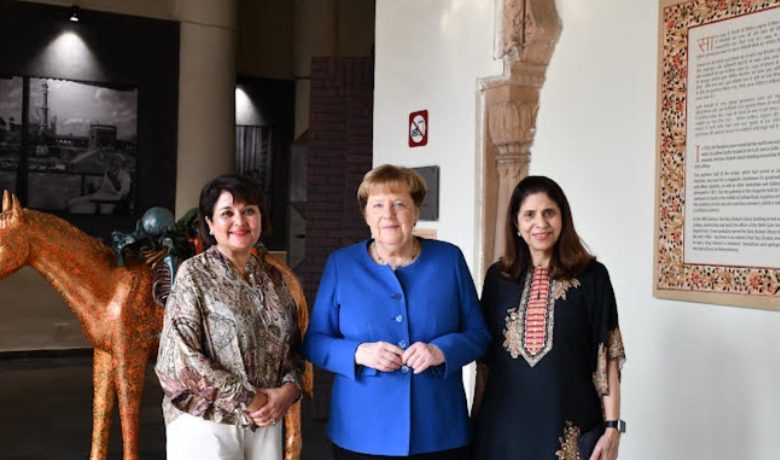
Former German Chancellor Dr. Angela Merkel’s visit to the Partition Museum, Delhi

February 2026
New Delhi: Former German Chancellor Dr. Angela Merkel, accompanied by the German embassy delegation, visited the Partition Museum at the Dara Shukoh Library Building on Thursday.
She was received by Kishwar Desai, Founder of Partition Museums in Amritsar and Delhi, and Chair of The Arts and Cultural Heritage Trust (TAACHT), and Dipali Khanna, Managing Trustee. Desai and Khanna welcomed the former Chancellor and led the delegation through the museum’s galleries, introducing them to the archival collections, personal artefacts, and oral histories that form the core of the institution.
Angela Merkel said:
Heartfelt thanks for the tour through this impressive museum. May it help ensure that future generations do not have to endure such suffering. All the best for this important place of history.
Commenting on the visit, Kishwar Desai said:
We are deeply honoured to welcome Dr. Merkel to the Partition Museum. Her visit reaffirms the universal importance of remembering the human stories of Partition, stories of resilience, courage, and hope that transcend borders. At a time when the world continues to grapple with displacement and division, this museum stands as a space for reflection, dialogue, and healing, and her presence here underscores the global relevance of that mission.
About the Partition Museum, Delhi
Established by The Arts and Cultural Heritage Trust (TAACHT) in 2015, the Partition Museum was created as a community-driven museum built with donations from survivors and their families. After opening the first museum in Amritsar, TAACHT expanded to Delhi, restoring the 17th-century Dara Shukoh Library to house the city’s first Partition Museum. The site, originally built by Dara Shukoh, the eldest son of Mughal Emperor Shah Jahan, adds architectural and historical significance to the museum’s work of remembrance and documentation.
The Delhi Museum showcases the city’s own transformation after 1947, when it absorbed a large influx of refugees and was reshaped demographically and culturally. Its galleries trace the political developments leading to Partition, the upheaval of migration, and the rebuilding of lives afterward. Personal objects ranging from family photographs and ration cards to an India–Pakistan passport issued to facilitate post-Partition travel ground the historical narrative in lived experiences. The museum also features recorded oral histories of survivors, forming an expanding archive for researchers and visitors. The museum functions as a hub for archives, exhibitions, events, and educational programs.