
CPI leaders and activists protest Mangolpuri against increasing AQI levels in Delhi and NCR

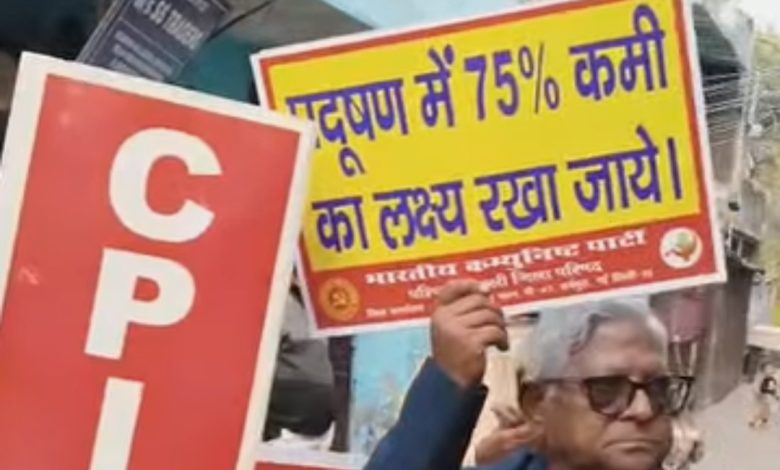


The Delhi population is adversely affected by the increasing AQI levels with going up to four hundred mark of even higher in several localities. Those suffering from critical illnesses like heart ailments, asthama, neurological ailment and infection in lungs are the worst sufferers in view of surging AQI levels in Delhi and NCR.
The situation has become so alarming and worrisome that even the two former directors of the All India Institute of medical Sciences have urged people to leave Delhi if they can as the pollution levels in Delhi has made their lives a hell not fit for healthy living. In view of the increasing AQI levels in Delhi and NCR, the Communist Party of India leaders and activists protested in Mangolpuri resettlement colony demanding CONTROL IN POLLUTION LEVELS IN DELHI.
According to the press release the CPI today on 7 TH DECEMBER 2025 held a Joint Left Parties, DELHI STATE protest rally AGAINST STIFLING AND SUFFOCATING POLUTION LEVELS IN DELHI AND AROUND NCR in Mangolpuri L block k, block.
THIS protest in the shape of various corner meetings in Mangolpuri was addressed by Prof. Dinesh Varshney Secretary CPI Delhi State Council and National Executive Member CPI. While addressing PROF. VARSHNEY said that Delhi have five engine government, yet they have not taken any decisive action against very dangerous levels of AQI. People of Delhi and around in NCR are compelled to live in medical emergency State of Pollution.Poor people’s are the worst sufferers said Comrade Dinesh Varshney.
Others who addressed were COM. Shankarlal, West Delhi district and Secretariat member of CPI Delhi State , Com. Mukesh Kashyap, AITUC DU, General Secretary AITUC, SHIJO VERGHESE, SECRETARY AIYF DELHI STATE and Assistant Secretary CPI West Delhi district, Shiv Kumar CPIM Delhi State committee member.
It was also led by COM. Rajesh Kashyap CPI West Delhi district Assistant Secretary, COM. Govind Jha, Secretary CPIM West Delhi district CPI district leader Brij Bhushan Tiwari, Ms. Anju, Ms. Sarita, Ms. Jyoti all NFIW West Delhi district leaders.







*Mangolpuri Protest by CPI leaders in Delhi is not the solution to AQI (Air quality Index), but we should all wholistically try to the causes of higher AQI & possible measures to control and minimise it. Let’s break down the issue of Air Quality Index (AQI) and analyze the causes and potential solutions thereto.*
*Causes of Higher AQI:*
1. *Vehicular Emissions:* Private vehicles, especially diesel and old petrol vehicles, contribute significantly to air pollution.
2. *Industrial Emissions:* Industrial activities, construction, and power plants release pollutants into the air.
3. *Agricultural Burning:* Burning crop residue in neighboring states contributes to Delhi’s air pollution.
4. *Construction and Demolition:* Unregulated construction and demolition activities release particulate matter into the air.
5. *Lack of Green Cover:* Insufficient green spaces and urbanization contribute to poor air quality.
*Measures to Control and Minimize AQI:*
1. *Promote Public Transport:* Encourage the use of public transport, carpooling, and non-motorized transportation.
2. *Electric Vehicles:* Incentivize the adoption of electric vehicles and phase out old, polluting vehicles.
3. *Renewable Energy:* Increase the use of renewable energy sources, such as solar and wind power, to reduce dependence on fossil fuels.
4. *Waste Management:* Implement effective waste management practices, including recycling and proper disposal of waste.
5. *Green Initiatives:* Plant trees, promote urban forestry, and create green spaces to absorb pollutants.
6. *Regulate Industrial Emissions:* Enforce strict emission standards for industries and monitor compliance.
7. *Agricultural Waste Management:* Encourage farmers to adopt sustainable practices, such as crop residue management, and provide support for alternative uses of crop residue.
*Logical Analysis:*
1. *Short-term Measures:* Implement emergency measures, such as odd-even vehicle restrictions, construction bans, and school closures, during peak pollution periods.
2. *Long-term Solutions:* Focus on sustainable development, infrastructure planning, and policy changes to reduce pollution.
3. *Collaborative Efforts:* Encourage collective action from government, industries, and citizens to address air pollution.
4. *Data-driven Decision Making:* Use data and research to inform policy decisions and evaluate the effectiveness of measures.
By analyzing the causes and implementing a combination of short-term and long-term measures, we can work towards improving Delhi’s air quality and reducing the AQI.