Ambedkar Rooted Fraternity in India’s Moral Tradition, Not Western Politics”: Justice Dhulia
“Equality Needs Fraternity to Survive”: Justice Dhulia Highlights Ambedkar’s Enduring Vision

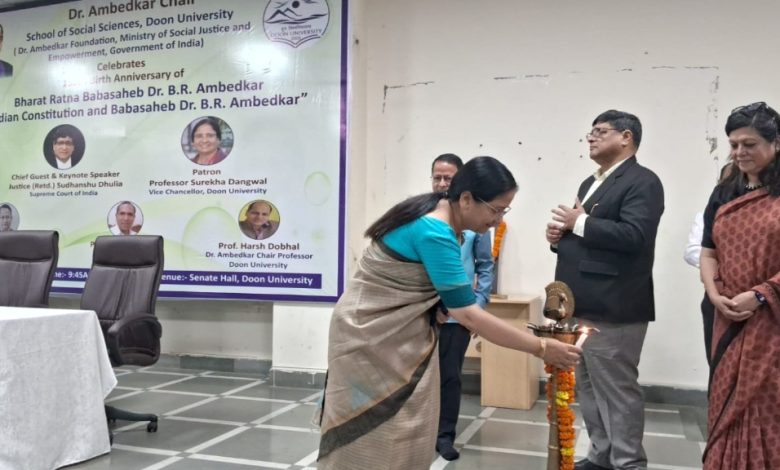
DEHRADUN, April 13: Dr. Ambedkar Chair at Doon University today hosted a prestigious day-long academic symposium to commemorate the 135th Birth Anniversary of Bharat Ratna Babasaheb Dr. B.R. Ambedkar.
The event featured Justice Sudhanshu Dhulia, former Judge of the Supreme Court of India, as the Chief Guest and Keynote Speaker, who delivered a profound address on the theme, “Indian Constitution and Babasaheb Dr. B.R. Ambedkar.”
Addressing a packed Senate Hall, Justice Dhulia provided an in-depth background Dr B R Ambedkar’s genius and of the spiritual and social foundations of the Indian Constitution.
In a standout moment of his address, Justice Dhulia distinguished Dr. Ambedkar’s concept of fraternity from Western political models, noting that while the French Revolution popularized “Liberty, Equality, and Fraternity” as a political objective, Ambedkar’s vision was uniquely rooted in Indian ethos.
Doon University Vice Chancellor Professor Surekha Dangwal in her inaugural welcome address stressed upon Dr. Ambedkar’s contribution not only as the main architect of the Constitution but also as a tireless crusader for women’s rights.
Welcoming the distinguished judge, academicians, researchers and students, Professor Dangwal expressed pride in “the university’s diverse student body, particularly the strong presence of female students, echoing Ambedkar’s vision of social empowerment.”
Elaborating upon Dr Ambedkar’s idea, Justice Dhulia noted that “for Dr. Ambedkar, Fraternity was not a mere political import from the French Revolution, which was essentially political in nature. He saw it as ‘Bandhutva’ or ‘Maitri’ – a deep-rooted Indian tradition.
“While law can mandate equality, only this spirit of brotherhood can safeguard it. Fraternity is the manifestation of selflessness; it is feeling for others as one feels for oneself,” Justice Dhulia emphasised while urging students to study Ambedkar’s historic speeches of 8 Nov 1948 and 25 Nov 1949 to understand the “nascent nature” of India at independence and the subsequent need for a detailed, value-driven Constitution.
Recalling Dr. Ambedkar’s lifelong “company of books,” Justice Dhulia advised students to never waste time and to pursue knowledge with academic hunger.
He encouraged students to explore Neo-realist cinema and the works of Satyajit Ray, noting that art is essential for inculcating empathy and understanding the dignity of all living beings.
Prof. Rajendra P. Mamgain, Dean of the School of Social Sciences described Dr. B.R. Ambedkar as a visionary reformer whose economic and social blueprints remain essential for a modern, progressive India.
He highlighted Ambedkar’s pioneering role in gender justice—notably through the Hindu Code Bill and the establishment of maternity benefits—and his forward-thinking economic strategies that positioned cooperative farming and technological advancement as the bedrock of industrial growth.
Addressing contemporary challenges, Prof. Mamgain noted that Ambedkar’s concept of “economic democracy” provides a vital framework for tackling rising income inequality and job insecurity today.
Dr. Ambedkar Chair, Professor Harsh Dobhal emphasised that Babasaheb Dr. B.R. Ambedkar’s contributions should not be confined to his role as the chief architect of the Constitution or as a champion of the oppressed as his vision extended to women’s rights, economic planning, water management, labour welfare, and social democracy, all of which remain deeply relevant today.

Professor Dobhal stressed that Ambedkar’s advocacy for gender equality, industrialisation, equitable resource distribution, and labour dignity reflected a holistic vision for a just and inclusive society, making his ideas crucial for addressing contemporary challenges and strengthening democratic values.
Prof. Ashish Kumar highlighted the importance of engaging with books and scholarly literature on Dr. B.R. Ambedkar, encouraging students to cultivate a habit of critical reading. He emphasised that a deeper understanding of Ambedkar’s writings offers valuable insights into the foundations of Indian democracy, constitutional values, and the social realities that continue to shape the nation.
The symposium was attended by a large number of academicians and students including Wg Cdr Anupama Joshi, historian Yogesh Dhasmana, Justice Dhulia addressing the gathering at Doon University Professor Chetana Pokhariyal, Professor Achlesh Daverey, Professor Himani Sharma, Dr Manvendra Barthwal, Dr Saumyata Pandey, Dr Rajesh Bhatt, Dr Kailash Kandwal, Dr Richa Joshi Pande, Ms Devyanjali Bijalwan, Dr Karuna Sharma, Ms Aabhsar Abbasi, Dr Khushboo, Dr Vandana Nautiyal, Ms Himani Peyashi, Dr Gitu Sharma, Mr Luv Mohan Sharma and others.