In 2026, Khadera Village of Salt Assembly-49 Still Carries Its Sick On A Charpoy For 7 KM – The Real Face of Uttarakhand’s Collapsing Health System

When Will The Hills Develop? In 2026, Khadera Village of Salt Assembly-49 Still Carries Its Sick On A Charpoy For 7 KM – The Real Face of Uttarakhand’s Collapsing Health System
Khadera, Salt – Almora / Dehradun:
“आखिर कब होगा पहाड़ों का विकास? आज 2026 में भी पहाड़ों के लोग मूलभूत सुविधाओं से वंचित क्यों हैं?”
This heart-wrenching question is not a slogan. It is the pain of *Khadera village, Salt Vidhan Sabha-49, Almora district.
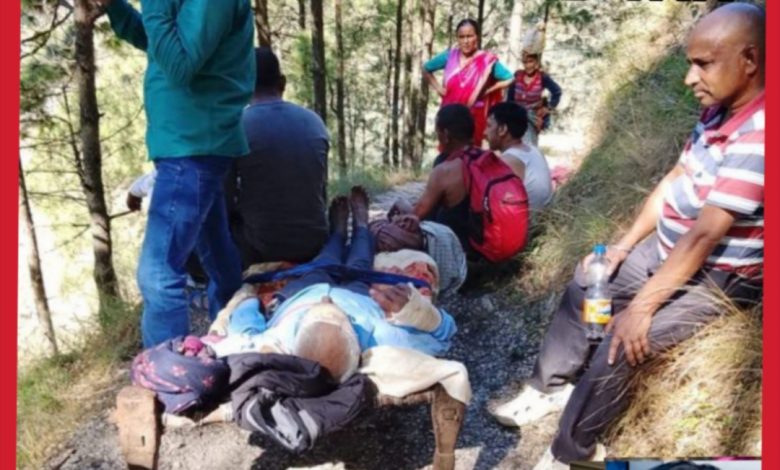
The video is brutal in its simplicity. A sick person, unable to walk, is tied to a charpoy and carried on shoulders for nearly 7 kilometers just to reach a road. There is no road, no ambulance can reach. And even more shocking – there is not even a stretcher to carry the patient. Villagers say they have to make a makeshift doli from wood and cloth.
“न क्षेत्र पंचायत सदस्य, न जिला पंचायत सदस्य, न ब्लॉक प्रमुख, न विधायक, न सांसद और न ही मुख्यमंत्री—किसी को भी पहाड़ की जनता की इस पीड़ा की फिक्र नहीं है। उत्तराखंड का विकास सिर्फ सोशल मीडिया पर दिखाई देता है।”
Khadera is not an exception. It is the norm in Uttarakhand in its 26th year.
Similar Horrors Across The State – A Pattern:
– In Pinau village, Dewal block, Chamoli in May 2026, villagers carried an ailing 65-year-old ex-armyman Kesar Singh on a makeshift stretcher for 12 kilometres to reach a hospital.
Village headman Lakhpat Danu said the proposal for the Dhura-Dharkot-Bank Pinau motorable road has been lying at the administrative level for nearly a decade.
– In Palla Kamaliya, a man carried his fever-hit wife 7 KM on his shoulders.
– In Thikalna village, Almora, villagers collected Rs 7 lakh and dug a 3 KM road themselves, still they carry patients in bamboo carriages.
– Just yesterday, a bride in Chakrata walked 18 KM in her lehenga to reach her in-laws house and appealed to CM Pushkar Singh Dhami for a road.
– At Almora’s Soban Singh Jeena Govt Medical College, the only major hospital for Almora, Bageshwar, Pithoragarh, Champawat – family members were seen carrying patients on shoulders as stretchers, wheelchairs were missing.
This proves: If it takes hours to reach the main road from the village, the entire healthcare system is weakened.
The State-Level Collapse: RTI and CAG Expose The Truth
The health crisis is not just about roads. Even if you reach a hospital, there is no doctor.
1. The 52,942 Referral Scandal:
According to RTI replies from Health Department dated Sept 26 and 30, 2026, 52,942 patients were referred to higher medical centres because required facilities were unavailable at government hospitals.
2. Only 295 Specialists Against 840 Posts:
Of 840 sanctioned specialist posts across CHCs, district and sub-district hospitals, only 295 doctors are working – 545 posts vacant.
– At 80 Community Health Centres (CHC): 401 posts sanctioned, only 55 working. *346 posts – 86% vacant. Of 81 physician posts, only 9 filled. Only 9 anaesthetists against 80 posts, only 11 surgeons against 80 posts.
– District Hospitals: 182 posts sanctioned, 65 vacant.
– Sub-district Hospitals: 257 posts sanctioned, 134 vacant.
3. Hill Districts Are The Worst Hit:
District-wise vacancy:
– Uttarkashi – 32 vacancies among 41 posts – 78%*
– Almora – 68 vacancies out of 89 – 76.4%
– Pauri Garhwal – 81 vacancies among 109 – 74.3%
– Bageshwar – 20 out of 27, Tehri – 58 out of 79
In Kumaon division alone in September 2025, 432 of 1,039 sanctioned doctor posts were lying vacant in six districts.
A 2024 CAG Report on public health infrastructure (2016-2022) noted shortage of 94% in CHCs, 45% in sub-district hospitals, 30% in district hospitals. Specialist posts in hill districts have 70% vacancy, compared to 50% in plains.
In Medical Education Dept, 64% doctor positions, 81% nurse positions and 79% paramedical staff positions were found vacant. In some mountainous districts, doctor shortage was as high as 75%.
4. Quality Failure At Decentralised Level:
An NHM review assessed nearly 99% of Uttarakhand’s ∼2,577 primary and secondary institutions – Sub Centres, PHCs, CHCs, sub-district and district hospitals – for Indian Public Health Standards. Most facilities fell under “Aspirant” category, scoring only 25-50%. The reason: vacant posts and lack of trained personnel.
Only 47 facilities – about 2% – have NQAS (National Quality Assurance Standards) certification.
Even essential medicines are missing. Uttarakhand has notified Essential Drug List – 74 medicines for Sub Health Centres, 135 for PHCs, ∼690 for secondary care – but actual availability was found far below prescribed levels.
At village level, the situation is: ANM sub-centre exists on paper, but ANM lives in town. PHC exists, but doctor comes twice a week. CHC is upgraded to a board, but functions only as a referral centre.
As State Legal Services Authority told Uttarakhand High Court: _“Most base and district hospitals were operating only as referral centres. People are vulnerable to landslides, but cannot even get basic care.”
Why Doctors Don’t Stay?
Government launched *“You Quote, We Pay”* scheme – doctors can quote their salary and govt will pay – to mitigate 45% shortage. It has failed. Fewer doctors want hill postings due to lack of housing, schooling, equipment, and safety.
Now government is drafting a policy of *mandatory 5-year service for MBBS graduates* before PG admission, and has terminated 56 bond-holder doctors for prolonged absenteeism. Of 1,067 specialist posts required, only 515 are filled.
The Bottom Line for Khadera:
Khadera’s pain is three-fold failure:
1. PWD/PMGSY Failure: Road not built despite PMGSY norm of 250 population for hill states.
2. Panchayati Raj Failure: Gram Panchayat, Kshetra Panchayat, Zila Panchayat, Block Pramukh – all exist, but no stretcher, no palanquin, no coordination with 108 ambulance service.
3. Health Dept Failure: Even if road existed, Salt CHC and Almora Medical College would have referred the patient further to Haldwani or Dehradun – 100-200 KM more, as patients in mountainous areas have to travel after being referred.
As Leader of Opposition Yashpal Arya said: “People face more difficulties during rainy season. This is the misfortune of this hill state.”
Uttarakhand was formed in 2000 on promise that hills would get development. 26 years later, a bride walks 18 KM in lehenga, a jawan is carried 12 KM on shoulders, and a patient from Khadera is carried 7 KM on a charpoy.
_ऐ छू मेरु देवभूमि उत्तराखंड! आखिर कब बदलेगी पहाड़ों की यह तस्वीर?_