Uttarakhand’s Electoral Roll Shrinks by 11.07 Lakh compared to the 2022 Vidhan Sabha elections as 13.40% Decline Raises Questions Ahead of 2027 Assembly Elections
Women Voters See Higher Percentage Reductions in 36 of 70 Constituencies , Rajpur Road Now Has Fewer Electors Than Badrinath & Kedarnath

SUNIL NEGI
Dehradun:
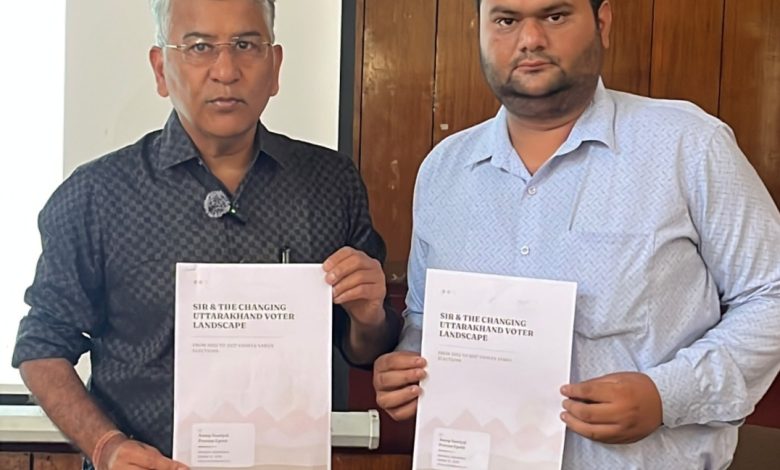
A report titled “SIR & The Changing Uttarakhand Voter Landscape From 2022 to 2027 Vidhan Sabha Elections” was released by social worker Anoop Nautiyal and Praveen Upreti at a press conference held at the Dehradun Press Club on Saturday, 17 October 2026. The report examines changes in Uttarakhand’s electoral rolls, compares available figures across states and raises important questions about the scale and distribution of voter reductions following the Special Intensive Revision (SIR).
The report’s central finding is that Uttarakhand’s electorate has declined by 11,07,695 voters, or 13.40%, between the 2022 Assembly elections and the final electoral roll published on 3 October 2026. The electorate has fallen from 82,66,644 to approximately 71.59 lakh. This is a substantial change in the voter base of a state preparing for its 2027 Assembly elections. Between 2012 and 2022, Uttarakhand had added approximately 18.89 lakh electors, making the sharp reversal in the latest figures particularly significant. The reasons for this reduction need to be explained transparently, with a clear account of deletions, deaths, migration, duplicate entries and other corrections.
The report’s state-wise comparison also places Uttarakhand’s 13.40% reduction as the largest decline in comparison to other states. The corresponding figures presented in the report include a reduction of approximately 11.4% in Uttar Pradesh, 8.79% in Tamil Nadu, 6.88% in West Bengal, 9.18% in Goa, 5.28% in Manipur and 0.7% in Punjab. Kerala recorded a decline of 1.12%, while Bihar and Assam recorded increases in their respective comparisons. These figures must be interpreted with care because the states have different reference years, publication dates and revision exercises. They are not a definitive like-for-like ranking. Nevertheless, Uttarakhand’s reduction is sufficiently substantial to require the ECI to publish a standardised comparison and explain the reasons behind the state’s “highest reduced” electoral landscape.
The decline is not uniform across the state. Dehradun district recorded a reduction of approximately 3.03 lakh electors, or 20.22%, the highest district-level percentage reduction identified in the report. Pauri Garhwal recorded a decline of 14.89%, Pithoragarh 13.61% and Tehri Garhwal 13.14%. At the constituency level, Dehradun Cantt recorded a reduction of 34.19%, Rajpur Road 32.64% and Dharampur 27.59%. These variations warrant a detailed explanation from the Election Commission of India (ECI). While a large reduction does not, by itself, prove that deletions were incorrect, the scale of the change makes constituency-wise disclosure and verification essential.
Anoop Nautiyal was critical of the Election Commission, saying that the findings raise serious questions about transparency, accountability & public confidence in the electoral process. “Democracy is weakened when citizens are left uncertain about whether their names remain on the electoral rolls, or are forced to navigate a complex process to establish their right to vote. The situation appears to have reached a point where voters are running after the Election Commission to protect their voting rights, instead of the Commission proactively reaching out to voters to ensure that no eligible citizen is left behind. The Election Commission must recognise that maintaining accurate electoral rolls is not merely an administrative exercise; it is fundamental to the credibility of elections and the health of our democracy. Transparency, timely disclosure of data & accessible grievance redressal are essential to restoring public trust,” he said.
The gender-wise findings raise an additional concern. According to the report, in 36 of Uttarakhand’s 70 Assembly constituencies, the percentage reduction in women voters is higher than the percentage reduction in male voters. This pattern is also evident in five districts: Udham Singh Nagar, Haridwar, Tehri Garhwal, Uttarkashi and Almora. The report further notes that Dwarahat was the only constituency in the 2022 Assembly elections where women voters outnumbered men; in the 2027 electoral-roll figures examined, no constituency has more women electors than men. These findings call for closer examination, rather than assumptions about the reasons. The ECI should publish constituency-wise and polling-station-wise gender-disaggregated data showing the number of male and female electors before and after revision, along with the reasons recorded for deletions. The recently announced Special Summary Revision must provide accessible opportunities for eligible women whose names are missing to enrol or correct their records.
One of the report’s most striking comparisons is between Rajpur Road in Dehradun and the Himalayan constituencies of Badrinath and Kedarnath. In 2022, Rajpur Road had 1,19,615 electors, compared with 1,04,795 in Badrinath and 93,016 in Kedarnath. In the final roll published on 3 October 2026, Rajpur Road had 80,569 electors, while Badrinath had 91,555 and Kedarnath had 85,924. Rajpur Road now has fewer electors than both constituencies. Its reduction since 2022 is 39,046 electors, compared with 13,240 in Badrinath and 7,092 in Kedarnath.
The report calls on the ECI to publish a complete constituency-wise and polling-station-wise account of the 11.07 lakh reduction, categorising deletions by reason and reconciling the figures with previous electoral rolls. It seeks a standardised comparison of Uttarakhand with other states, using clearly identified reference dates and revision methods. It also calls for a gender-wise review of all 70 constituencies, with particular attention to the higher percentage reduction among women voters in 36 seats. The report further demands a detailed review of exceptional reductions in Dehradun Cantt, Rajpur Road and Dharampur, alongside a reconciliation of the ASDD and “no mapping” figures for Rajpur Road, Badrinath and Kedarnath and other similar constituencies. Finally, the ECI should ensure that the ongoing Special Summary Revision is transparent and accessible, allowing eligible voters to check their names, submit claims and corrections, and track applications and grievances through timely public reporting.
Anoop Nautiyal said that the objective is to strengthen electoral transparency, public confidence and the fundamental right of every eligible citizen to be registered as a voter. He thanked his colleague Praveen Upreti for his valuable contribution to the data collection and documentation that made the report possible.