Gas Cylinder Crisis Hits Food Businesses in Dehradun, Reveals SDC Foundations Rapid Survey
Food Business Operators Face Revenue Losses, Operational Strain Amid Supply Uncertainty

SUNIL NEGI
Dehradun:
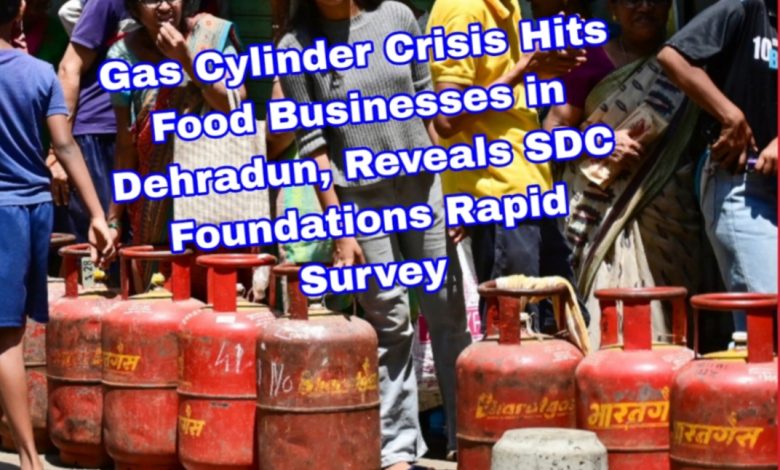
A two day rapid survey of 10 food business operators conducted by Praveen Upreti and Pyare Lal from SDC Foundation has highlighted the severe impact of the ongoing gas cylinder crisis on food businesses in Dehradun. The rapid survey, carried out on March 25 and 26, 2026, covered food outlets across Rajpur Road.
It provides a ground-level understanding of how disruptions in LPG supply are affecting daily operations. The findings reflect widespread challenges faced by small and medium food establishments.
The rapid survey covered 10 food business operators; including cafes, restaurants, sweet shops, and a hotel. Most of these businesses operate on a small scale, with six outlets serving fewer than 100 customers daily before the crisis.
This makes them particularly vulnerable to supply disruptions and revenue shocks. The study highlights how such businesses are struggling to maintain operations under current conditions.
Commenting on the findings of the rapid survey, Anoop Nautiyal, founder of SDC Foundation, said that one of the key findings of the survey is that 100 percent of the businesses reported being affected by the gas cylinder shortage.
LPG remains the primary fuel source for all surveyed outlets, with many heavily dependent on it. While some businesses also use electric appliances, LPG continues to be essential for core cooking activities. The disruption has lasted between one week to over a month for different establishments.
In terms of financial impact, the survey reveals significant revenue losses across the sector. Around half of the businesses reported a decline of 25 to 50 percent in their earnings. Some establishments reported losses of over 50 percent, while others experienced smaller but still notable declines.
This indicates a widespread financial strain on food businesses in the city.
Operational adjustments have become a necessity for survival during the crisis. Eight out of ten businesses have reduced their menu offerings to conserve fuel. A few have also cut down their operating hours, while others are managing with limited resources. These changes are affecting both service quality and customer experience.
Interestingly, most businesses have not significantly increased prices despite rising challenges. Seven out of ten respondents reported no increase in operating costs, suggesting that businesses are absorbing losses instead of passing them on to customers. This reflects the competitive nature of the market and concerns about losing customers. However, this approach may not be sustainable in the long run.
Food businesses are adopting various coping strategies to deal with the crisis. These include reducing menu items, using backup cylinders, and exploring alternative cooking methods. A large number of outlets have started using induction cooktops and electric appliances.
This indicates an early shift towards alternative energy sources, although it is still limited.
Looking ahead, many businesses are considering long-term adaptations to reduce dependency on LPG. Six out of ten respondents prefer a hybrid system combining LPG and electric cooking. Others are exploring a complete shift to electric cooking.
However, all respondents cited high costs as the biggest barrier to adopting alternative solutions.
Despite operational difficulties, customer demand has remained largely stable across all surveyed outlets. However, business owners and managers expressed uncertainty about the future. All respondents indicated concerns about the next one to two months. Supply uncertainty remains the most pressing issue for the sector.
Anoop Nautiyal concluded that “This rapid survey clearly shows that the gas cylinder crisis is not just a supply issue but a serious economic challenge for small food businesses. While these establishments are showing resilience, their coping mechanisms are limited and may not sustain over time. There is an urgent need for reliable supply systems and support for alternative energy transitions. It is therefore vital that government agencies speak directly to stakeholders and take them into confidence. We will share the report with relevant govt agencies soon and will urge them to undertake similar initiatives.”
The survey highlights the need for policy-level interventions to address the crisis. Ensuring consistent LPG supply, promoting alternative energy solutions, and providing financial support to small businesses are critical steps. Without timely action from the government, the crisis could have deeper economic consequences. The findings aim to inform stakeholders and push for practical solutions.